
An HR course is not an entry-level car-driving course. Before choosing a date, work through your licence history, WA status, eyesight and any condition that could affect training. Each item answers a different question: whether you meet the experience requirement, whether you can undertake training and assessment, and whether a health issue needs attention before your booking is confirmed. Here is how HR licence eligibility applies to your next step with us.
For our HR course, you need a valid WA C-class licence held for at least two years, or an LR or MR licence held for at least one year. You must not be a provisional licence holder when applying for the heavy vehicle class. These are alternative experience routes, not milestones to accumulate together. Your starting point is the class you hold and the time you have held it.
Start With the Class and the Time Held
A driver with two years on the qualifying C class follows the car-licence route; a driver who has held LR or MR for the required year follows another. You do not need to progress through both LR and MR before considering HR. The useful detail is your actual licence history, not simply how long you have felt confident driving or how much driving you do for work.
Age, USI and English Requirements
You must be at least 18 to enrol in our HR course. You also need a valid Unique Student Identifier, or USI, before commencing training, and we cannot issue a Statement of Attainment without a verified USI. Treat the USI as part of your enrolment preparation alongside your licence details. It serves a different purpose from demonstrating that you have held the qualifying licence for long enough.
Our course requires basic to intermediate English skills, including the ability to listen, understand instructions and participate in theory and practical training. All reading, writing and assessment tasks are conducted in English. Think about both parts of the learning experience: following spoken instructions in the vehicle and working through written assessment material. Our student information brings together the handbook and enrolment policies for further preparation.
Resolve Your WA Licence Position Before the PDA
Interstate and international licence holders must transfer their licence to WA before sitting the practical driving assessment, commonly called the PDA, with us. This is a timing requirement, not something to leave until after assessment day. When describing your situation, distinguish between a transfer you have completed and one you intend to arrange. That distinction helps keep the training discussion tied to your actual licence position.
Transferring an existing class is different from upgrading to HR. A current interstate driver’s licence for any vehicle class can be transferred to a WA driver’s licence without completing a PDA. This includes transferring an existing interstate HR licence; it does not mean a driver transferring a C-class licence receives an HR upgrade without assessment. Transport WA’s HR licence guidance explains the experience requirements and transfer pathways.
If you hold a heavy vehicle licence from a country other than New Zealand, previous driving experience may be recognised when applying for a WA licence. Take that question to a Department of Transport and Major Infrastructure service centre or regional agent. Describe the country, licence class and experience accurately, and establish how your existing entitlement will be treated before planning an HR upgrade around it.
Meet the Commercial Eyesight Requirement
You must meet the required commercial-vehicle eyesight standard. If you wear glasses or contact lenses while driving, you must wear them for the test.
Licence tenure and eyesight are separate requirements, and you must meet both.
Disclose Conditions That May Affect Training
When you book with Blue Horse Truck Driver Training, tell us about any medical condition, restriction or disability that may affect your training before confirming your booking. In some cases, the matter may need referral to the Department of Transport for approval. Disclosure is not the same as receiving clearance.
Examples of matters to disclose include hearing impairment, dyslexia, or an injury to an arm or leg. Describe the particular difficulty or restriction and how it affects you, without trying to decide the medical outcome yourself. For example, an explanation of difficulty reading assessment instructions is more useful than a general statement that you might need help. The aim is an accurate account of your needs before arrangements are finalised.
Support may include one-on-one assistance, additional time or clarification, or referral to external support services. Raise learning needs during enrolment so the discussion can focus on the part of training you find difficult. Do not assume that support changes the assessment standard or guarantees completion. A useful conversation separates the assistance you need from the skills and knowledge you will need to demonstrate.
Understand the Eligibility Steps Before Assessment
For training or a PDA through an approved registered training organisation, eligibility must be verified through the Licence Assessment Provider System, known as LAPS. You need to complete and sign the Heavy Vehicle PDA Customer Eligibility form, E114, and pass a commercial vehicle eyesight test. These formal steps are separate from an initial conversation about a course date. Completing an inquiry or expressing interest does not replace them.
Training and assessment will not proceed if you fail the eyesight test, do not declare commercial-standard medical eligibility, do not declare an alcohol interlock condition or restriction, or do not complete the relevant training module. In those circumstances, you will be referred to DTMI. The official training and assessment guidance explains these requirements. Give complete information on the eligibility paperwork, including relevant restrictions that might otherwise be overlooked.
Course Completion Comes Before the Licensing PDA
Our HR course includes online theory and practical assessments for TLIC3004 Drive Heavy Rigid Vehicle. Successful completion of the unit leads to a Statement of Attainment, followed by eligibility to undertake the Department of Transport PDA with our approved assessors. This sequence matters: the course assessment establishes completion of the training unit, while the PDA is the licensing assessment. They should not be treated as interchangeable descriptions of the same result.
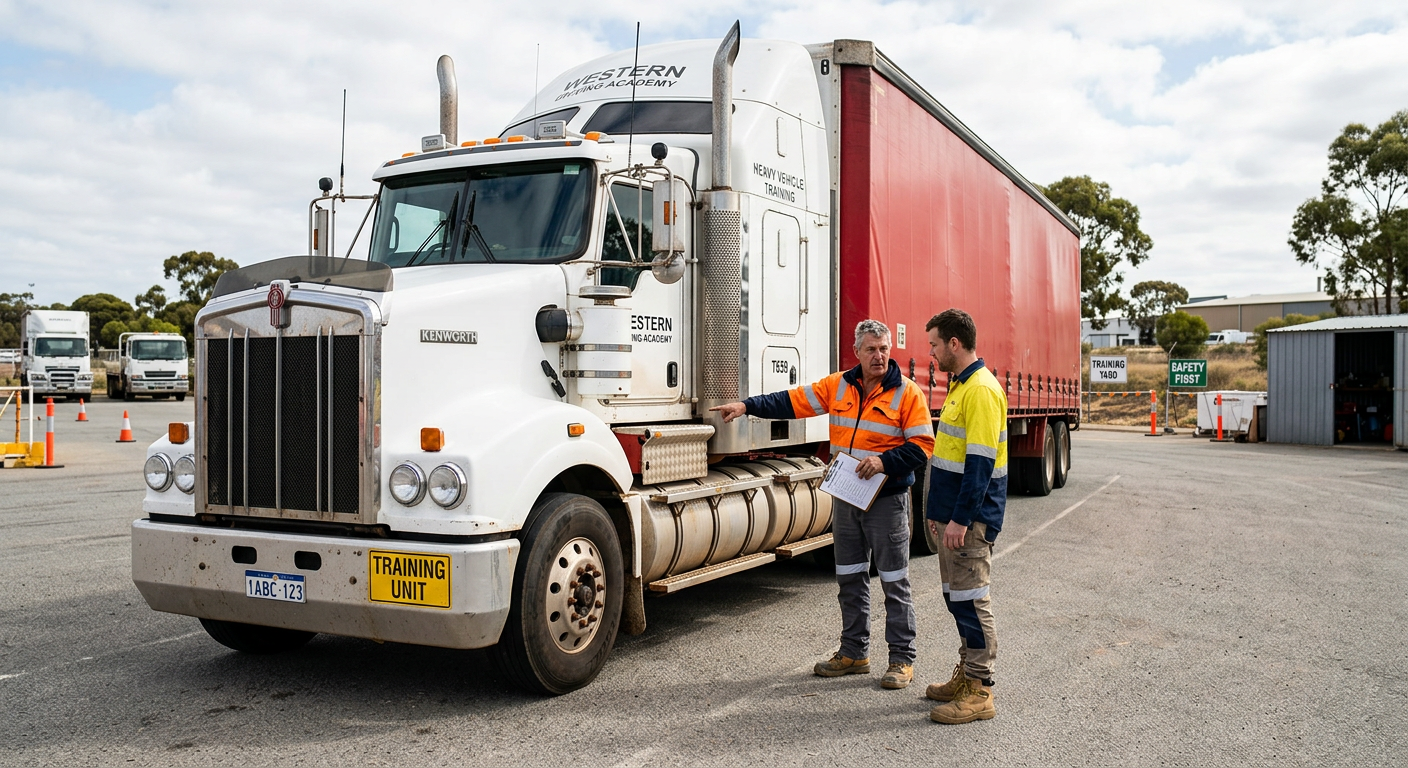
We offer one day of one-on-one training with experienced, accredited trainers and assessors. The course covers safe driving techniques, control of vehicle functions, monitoring traffic and road conditions, managing vehicle condition and performance, and responding to hazards.
Prepare for Assessment and Licence Endorsement
For practical training, wear comfortable clothing suitable for the activities and closed-in shoes. Preparation should cover the ordinary details as well as the licence paperwork: allow time to arrive, bring your usual driving lenses if needed, and organise your enrolment information in advance. Keeping these tasks out of the last few minutes gives you more room to concentrate on instructions and the practical work ahead.
On the day of your PDA, we must confirm your eligibility again. If you are not eligible, the PDA will be cancelled; an expired driver’s licence is one example. A previous discussion about entry requirements is therefore not the final eligibility decision for assessment day. Keep your licence validity in view throughout the booking period, particularly if a renewal falls between your initial enquiry and the planned assessment.
After passing the PDA, you must visit a DTMI service centre or regional agent to have your licence endorsed before you are authorised to drive the heavy vehicle. Bring a photocopy of the completed E114 signed by the RTO and your proof of identity documents. Plan this final administrative step as part of the upgrade, not as optional paperwork after you have already started driving in the new class.
Bring the Right Details to Your Enquiry
A useful pre-booking record contains your current licence class, the date you first held it, whether it is provisional or non-provisional, its issuing state or country, its expiry date, and any relevant conditions. If you recently changed classes, keep the earlier history separate from the date printed on a replacement card. Add your USI and any learning or health matter you need to discuss. If a transfer is involved, note its current stage. This short record keeps the conversation focused on your circumstances without repeating every requirement or guessing which detail matters most.
The HR course requirements are best approached as a sequence, from the qualifying licence history through training, assessment and endorsement. If you are ready to discuss your own pathway, contact us with your licence class, time held and any transfer or support details. We can then focus the enquiry on your starting point and the arrangements you need to discuss before booking.






Leave A Comment