
Choosing to investigate HC training is usually less about collecting another credential and more about the direction of work you want to explore. Start with the operating environment and responsibilities that interest you, then consider how training fits that direction. A licence decision should serve a work goal, not stand in for one.
For drivers already working around transport, career changers and employees considering a future workplace requirement, the starting questions are different. You might be pursuing a specific position, exploring a new field or responding to an employer’s suggestion. Give that reason a clear shape before committing time and money to a course.
Begin With the Work, Not the Licence Label
Read several role descriptions with a notebook beside you. Look for the details that would affect your own decision: where the work begins and ends, whether the advertised duties involve local or longer runs, the sites mentioned, the stated roster and the responsibilities alongside driving. Treat these as details to investigate, not evidence that every HC role follows the same pattern.
Picture two possible working arrangements: a regular route with familiar delivery points, and work across changing locations and schedules. These are illustrations, not advertised opportunities. Which arrangement would better suit your commitments and preferences? Thinking through the difference gives you a more useful starting point than deciding that any job with an HC requirement would suit you.
The point is not to turn advertisements into promises. Use each listing to identify what you still need to understand. Separate essential requirements from preferences, and record any duties you would want explained in an interview. For someone exploring a heavy vehicle driving career in Perth, a specific picture of the work is more useful than a broad ambition to drive bigger trucks.
Understand What HC Actually Covers
In WA, an HC licence allows you to drive a prime mover with an attached single semi-trailer, or an HR vehicle with an attached trailer whose gross vehicle mass exceeds 9,000 kg. It also includes HR, MR, LR, car and moped entitlements. You may tow one other trailer in addition to the attached trailer or semi-trailer, provided that additional trailer has a maximum GVM of 9,000 kg. An unladen converter dolly or low loader dolly is also permitted. These allowances mean that trailer count alone does not determine whether MC is required. A description of the vehicle, trailer arrangement and relevant GVM limits is more informative than an informal label such as “large truck”.
The WA HC pathway requires applicants to be non-provisional licence holders who have held a C class licence for at least three years and an MR or HR licence for at least one year. HR is therefore not the only qualifying rigid class. Put your licence history beside those requirements early, so your career planning reflects the route available to you.
HC and MC are not interchangeable. An MC licence covers heavy combination units towing two or more trailers, each with a GVM greater than 9,000 kg. The WA experience requirements for MC are a C class licence held for at least three years and an HR or HC licence held for at least one year. This means HC is not a compulsory intermediate step for every eligible HR licence holder considering MC. Choose the class that relates to the intended vehicle combination, rather than assuming every upgrade must follow the same sequence.
Treat Employer Language as Evidence to Examine
Read beyond the licence requirement in a role description. For your comparison notes, use categories such as customer interaction, pre-start duties, paperwork, site procedures, delivery timing and teamwork. Record only what the employer actually specifies, leaving gaps visible. This avoids turning an illustrative list of possible responsibilities into assumptions about a particular job.
Compare a small group of roles rather than anchoring your plans to one vacancy. If one advertisement calls a qualification essential while another describes it as desirable, keep that distinction visible. Your aim is to understand the positions you would realistically pursue, not to construct a universal industry rule from a handful of listings.
For work connected to your current employer, establish the expected duties and timing directly with the business. A statement such as “you may need HC later” leaves too much unresolved for a booking decision. A clearer brief would identify the proposed vehicle combination, the responsibilities involved and when the business expects that capability to be needed. Keep unresolved workplace arrangements explicit, and any discussion about a future opportunity separate from a firm offer of work.
Consider the Operating Judgement Behind the Role
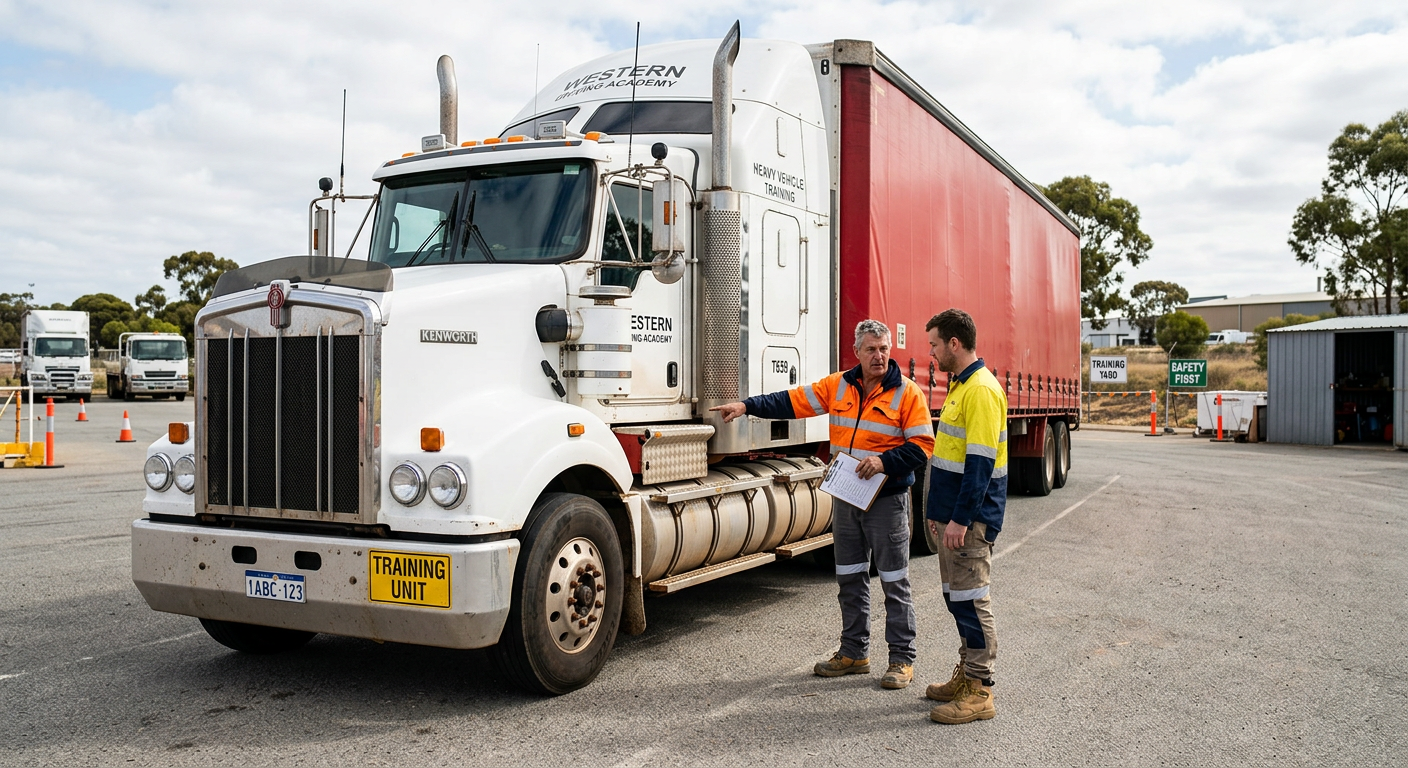
Our HC training covers safe driving techniques, systematic control of vehicle functions, monitoring traffic and road conditions, managing vehicle condition and performance, and responding to hazardous situations. Use those themes to think about the responsibility you want to take on. The appeal of the vehicle itself is only one part of deciding whether this learning direction interests you.
With Blue Horse Truck Driver Training, our one-on-one training gives you individual instruction while you work on driving techniques. Bring a specific learning goal to that setting: for example, developing a more methodical approach to observing conditions or understanding how your control inputs affect the vehicle. Relating your goals to the training makes the inquiry about learning, not simply obtaining another licence class.
Think about how you approach sustained concentration, planning and changing conditions. You may enjoy the prospect of operating carefully in a busy road environment, or discover that your interest in transport points towards a different kind of responsibility. Speak with people familiar with the workplace you are considering and distinguish enthusiasm for trucks from your willingness to undertake the routine duties described.
Separate Training, Assessment and Licence Endorsement
Our HC training covers TLIC3005 Drive heavy combination vehicles, with two-day one-on-one training. Successful completion of the unit and issuance of a Statement of Attainment make you eligible to undertake the Practical Driving Assessment for the licence upgrade. The training period is a course arrangement, not a promise that every learner will finish with the same result or be ready for a particular employer’s work.
Under WA assessment requirements, an RTO must verify your eligibility through the Licence Assessment Provider System. You must complete and sign Form E114 and pass a commercial vehicle eyesight test. Training and assessment will not proceed if the required commercial-standard medical eligibility or alcohol-interlock declarations are not made. Raise any relevant circumstances before booking so they can be addressed through the appropriate process.
Passing the PDA is not the final administrative step. You must visit a DTMI service centre or regional agent to have your licence endorsed, and you are not authorised to drive the heavy vehicle until that step is complete. Keep this distinction in your planning if an employer is discussing a possible start date. Course completion, a successful driving assessment and licence endorsement are separate milestones.
Transmission restrictions also matter when comparing the intended vehicle with your licence. An A restriction permits automatic transmission only; a B restriction permits automatic or synchromesh transmission. Include the intended gearbox in your training enquiry, alongside the vehicle combination. A licence-class label alone does not resolve whether a particular transmission is covered.
Match the Decision to Your Starting Point
If you already drive for work, focus your research on what would change. Compare the proposed combination and duties with your current responsibilities. Identify the parts you understand well and the parts you would need to learn. A specific target position or employer discussion provides a firmer reason to explore HC than a general feeling that a higher class must be better.
If you are changing careers, build a grounded picture of the working environment before choosing a course date. Consider how the rosters and travel described in the roles you find would fit your household, current employment and preferred routine. Write down your non-negotiables alongside the things you are willing to change. This makes it easier to recognise a suitable direction without treating every transport role as equivalent.
Give Time and Costs a Place in the Decision
Make room in your planning for training, assessment arrangements, travel and any time away from existing work. Our student information includes the student handbook, cancellation/no-show policy, fees and refund policy, and schedule of fees and charges. Read the relevant documents alongside your proposed dates, then resolve any unclear booking terms before committing. A useful budget reflects your own circumstances, not just the headline idea of an upgrade.
Prepare a short enquiry brief containing your current licence classes and how long you have held them, the work direction you are investigating, the intended combination and gearbox if known, and your available dates. Add any learning or medical circumstances relevant to discussing your training. The brief does not need to prove that you are ready for a job; it gives the next conversation a practical purpose.
Make the Training Decision After the Work Decision
HC licence training in Perth makes most sense when your intended work, qualifying licence history and learning goal line up. If your preferred role is still vague, spend your next effort defining it. If the vehicle combination and work direction are clear, use that information to discuss the training route. The decision is not whether another credential sounds worthwhile, but whether this particular step serves the work you want to pursue.
When you have that brief ready, contact us to discuss your licence history, intended vehicle combination and HC training goals. We can make the conversation specific to what you want to learn while keeping employer expectations and the licensing milestones distinct.



Leave A Comment