
If you are wondering what you can drive with an HR licence, start with three boundaries: vehicle class, trailer size and transmission. In Western Australia, a Heavy Rigid licence covers rigid vehicles with three or more axles and a gross vehicle mass (GVM) greater than 8,000 kg. It also includes lower vehicle classes and permits a trailer with a maximum GVM of 9,000 kg.
Those permissions do not mean every large truck is covered. A prime mover pulling a semi-trailer belongs to a different class, while an automatic-only restriction still matters in an otherwise suitable HR truck. Separating the vehicle’s configuration from its gearbox makes the answer more useful when choosing training or considering a vehicle for work.
The Central HR Vehicle Definition
The words “heavy rigid” are doing important work. The HR definition combines a rigid vehicle, three or more axles and GVM above 8,000 kg. A three-axle rigid truck above that weight is the straightforward example. Its appearance, body style or commercial use is not enough to establish the class; the configuration and vehicle details provide the useful starting point.
Count the axles on the rigid vehicle itself, not across a truck and its trailer. The three-or-more-axle requirement describes the HR vehicle, while the trailer has its own weight boundary. Similarly, “greater than 8,000 kg” does not include exactly 8,000 kg. These distinctions help you read a vehicle description accurately without treating every reference to a heavy truck as the same licensing category.
Lower Classes Are Included
An HR licence also permits Medium Rigid (MR) vehicles, Light Rigid (LR) vehicles, cars and mopeds. These entitlements appear in the official HR licence guidance. This matters when a role involves more than one size of vehicle: the HR class includes the named lower classes, so the answer is broader than the central three-axle HR definition alone.
A two-axle rigid vehicle above 8,000 kg GVM falls within the MR definition, not the HR vehicle definition. An HR holder can nevertheless drive an MR vehicle through that included entitlement, subject to applicable restrictions and conditions. It would therefore be misleading to say that an HR holder cannot drive a two-axle truck simply because it does not meet the three-axle HR definition.
The inclusion does not work upward. Having MR and LR entitlements within HR does not give you HC or MC authority. Where a business operates both rigid trucks and articulated equipment, describe the actual vehicle you expect to drive. A job title such as “truck driver” does not distinguish between those configurations, and a familiar-looking cab does not resolve the trailer question.
The Trailer Limit Is 9,000 kg GVM
An HR holder may tow a trailer with a maximum GVM of 9,000 kg. The figure is a GVM limit, so use the trailer’s stated GVM when comparing it with the licence entitlement. An informal description such as “a small trailer” or an estimate of today’s load does not answer the same question. Keep the trailer information separate from the towing vehicle’s axle count and GVM.
For a practical boundary example, compare two otherwise similar HR rigid trucks: one has a trailer rated at 9,000 kg GVM, and the other has a trailer rated above 9,000 kg GVM. The first is within the HR trailer allowance; the second is beyond it. That example concerns the licence class only, not whether either particular truck and trailer is suitable for the intended load.
Treat the licence entitlement as one part of vehicle selection, not permission to disregard load or towing limits. The 9,000 kg figure answers the licensing question about the trailer; it is not a recommendation to attach a trailer of that size to any HR truck. Keep the distinction clear between the scope of the driver’s licence and the suitability of the equipment for the proposed task.
With our HR training at Blue Horse Truck Driver Training, we can help you connect the transmission option to the vehicles you intend to drive. An automatic option and a Road Ranger/open option have different gearbox scope within the same HR class. The useful training decision is therefore not simply which licence name sounds largest, but which transmission outcome fits your intended driving.
When the Configuration Is HC Instead
A prime mover with a single semi-trailer is an HC configuration, as is an HR vehicle towing a trailer with GVM greater than 9,000 kg. Our HC course addresses that next combination class. If either configuration is the reason you want to train, choosing a different HR gearbox option will not resolve the class mismatch.
Trailer count alone is not a reliable shortcut to MC. Official HC licence guidance allows an HC holder to tow one additional trailer with a maximum GVM of 9,000 kg, as well as an unladen converter dolly or low loader dolly. The complete arrangement matters, so “two trailers always means MC” would give the wrong answer for some combinations.
When the Configuration Is MC Instead
MC covers a heavy combination unit towing two or more trailers, each with GVM greater than 9,000 kg. Our MC course is the relevant training comparison for combinations such as B-doubles and road trains. This is a different entitlement from HR, not an extension gained by selecting an unrestricted HR transmission. Match the intended combination to its class before considering the gearbox choice.
Transmission Still Applies Inside HR
We offer three HR transmission options: automatic, synchromesh and Road Ranger/open. HR-A is automatic only. HR-B permits automatic and synchromesh gearboxes. Our Road Ranger/open option covers automatic, synchromesh and crash-box, or double-clutch, HR transmissions. The options on our HR course therefore address a real difference in which HR vehicles you can operate, rather than three names for the same outcome.
Imagine a three-axle rigid truck above 8,000 kg GVM with no trailer. Its vehicle configuration fits HR, but an HR-A holder cannot treat a synchromesh gearbox as covered by automatic-only authority. Equally, HR-B does not cover a non-synchromesh gearbox. The class and transmission permissions must both fit the vehicle; satisfying one does not cancel the other.
“Open” refers to the gearbox scope within the class, not freedom from every licence condition. Transport WA identifies A as automatic only and B as automatic or synchromesh only, and notes that additional restrictions may apply. Its licence restrictions guidance explains the codes. Use your actual licence conditions when deciding whether you can drive a particular vehicle, including any requirements separate from transmission.
What Our HR Course Covers
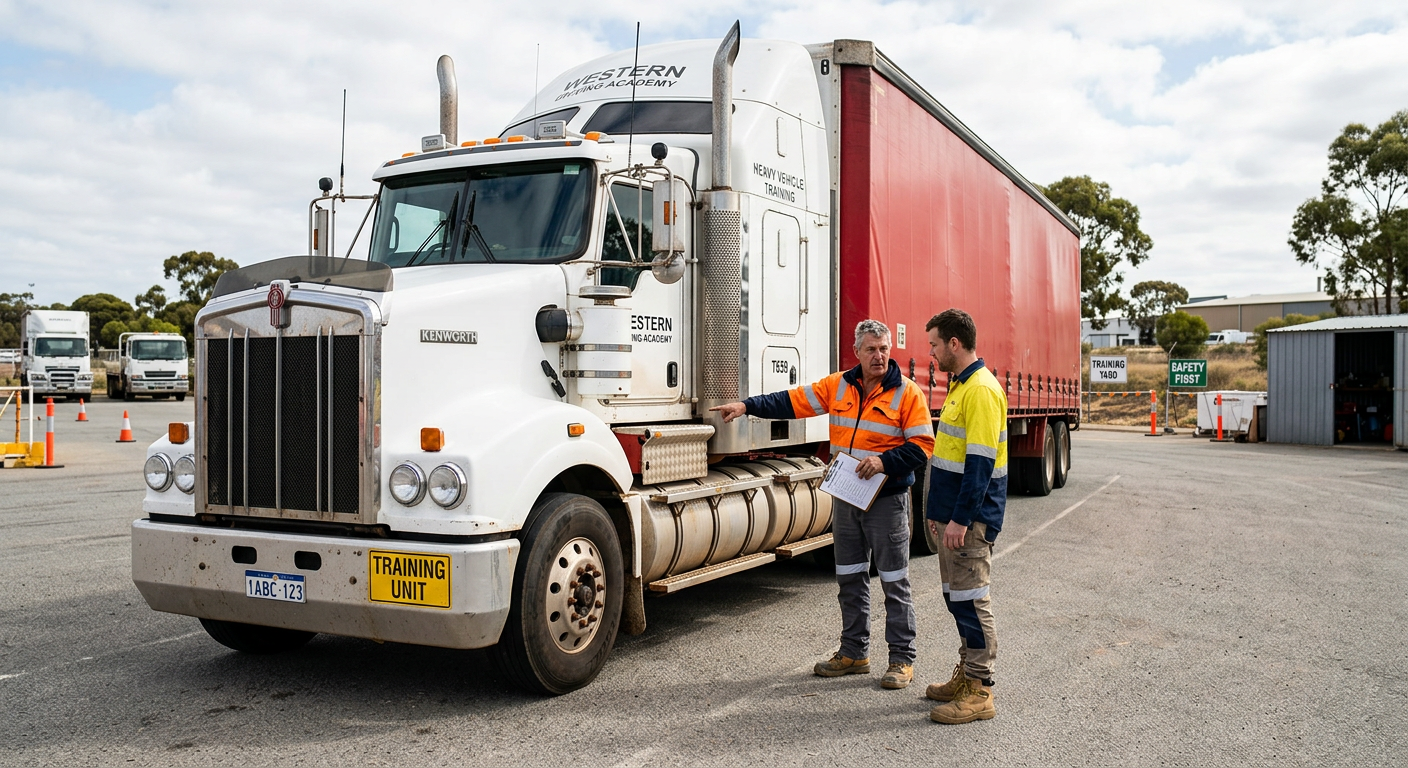
Our HR course is TLIC3004 Drive heavy rigid vehicle. It covers safe driving techniques, systematic control of vehicle functions, monitoring traffic and road conditions, managing vehicle condition and performance, and responding to hazards. These are practical skills for operating the vehicle, not simply learning the class definition. Knowing which truck your licence covers and learning to control that truck safely are related but different parts of preparation.
The training pathway also distinguishes the unit from the licensing assessment. Successfully completing the online theory and practical assessments leads to a Statement of Attainment for TLIC3004. Completing the unit and receiving that statement are part of the pathway to the Practical Driving Assessment (PDA), but do not establish eligibility on their own. For an HR application, you must not be a provisional licence holder and must have held a C-class licence for at least two years, or an LR or MR licence for at least one year.
The approved RTO must verify your eligibility through the Licence Assessment Provider System. This involves completing and signing the Heavy Vehicle PDA Customer Eligibility form, passing a commercial vehicle eyesight test and making the required declarations about commercial medical eligibility and any alcohol interlock condition or restriction. Eligibility is confirmed again on the day of the PDA; an expired licence, for example, makes you ineligible. Completing training does not remove these requirements.
After passing a PDA through an approved RTO, you must visit a DTMI service centre or regional agent to have your licence endorsed before you are authorised to drive the heavy vehicle. The official training and assessment guidance sets out that final step. Allow for it in your plans instead of assuming that leaving the assessment vehicle means the administrative process is complete.
Match Your Training to the Intended Vehicle
The most useful starting point is a specific vehicle description: rigid or articulated, the rigid vehicle’s axle count and GVM, any trailer’s GVM, and the transmission. Keep those details together when comparing a work opportunity with your intended licence outcome. Resolve the vehicle class first, then the gearbox scope within that class, so your training choice addresses the actual driving requirement.
If you have a vehicle or role in mind, contact us with those details so we can discuss the relevant HR transmission option or whether the proposed combination points to another licence class. That gives your enquiry a clear purpose and helps you choose training around the driving you actually intend to do.

Leave A Comment