
The licence class follows the vehicle combination, not the other way around. If your starting question is “which truck licence do I need?”, begin with the truck and trailer arrangement you need to operate. The useful starting point is a description of the vehicle, not simply the name of the job you want.
The HR HC MC licence difference is not simply a progression from smaller to bigger trucks. Vehicle configuration, trailer GVM and transmission restrictions all matter. We offer HR, HC and MC training, but choosing the appropriate course starts with separating the vehicle you need to drive from the licence history you already have.
Begin With the Vehicle Configuration
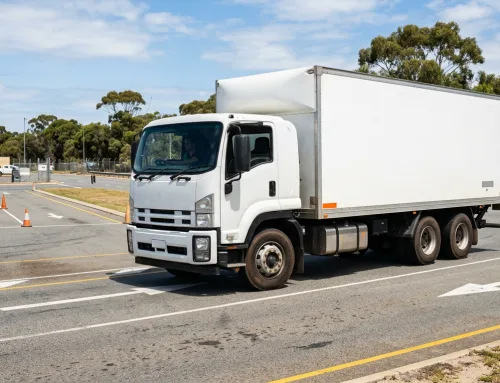
Before choosing a course, write down whether the towing vehicle is a rigid truck or a prime mover. Add the rigid vehicle’s axle count and GVM, the number of trailers and each trailer’s GVM. Use those details to describe the intended combination accurately when discussing a vacancy or planning an upgrade.
Treat the trailer as a separate part of the decision. Descriptions such as “rigid work”, “semi work” or “multi-trailer work” can leave important details unstated. A useful vehicle description includes the trailer arrangement as well as the truck, so the conversation does not depend on what someone means by a general job title.
HR: A Heavy Rigid Vehicle With a Defined Trailer Limit
Transport WA’s HR licence guidance defines an HR vehicle as having three or more axles and a GVM greater than 8,000 kg. An HR licence also allows a trailer with a maximum GVM of 9,000 kg. Those two parts belong together when identifying a rigid truck and trailer combination.
The axle wording is important. A vehicle is not an HR vehicle merely because it is large, commercial or carrying a heavy load. An HR licence also covers MR, LR, car and moped vehicles. The three-axle threshold defines the HR vehicle category; it does not exclude lower-class MR vehicles from an HR holder’s authority.
For a practical boundary example, take a qualifying HR rigid truck towing a trailer with a GVM of exactly 9,000 kg. That trailer is within the HR maximum. Change only the trailer to one with a GVM greater than 9,000 kg and the combination falls within HC. The truck may be the same; the licence-class answer changes because the trailer is not.
Match the HR Transmission to the Work
Transmission is a second decision, not a class upgrade. Our HR course offers automatic, synchromesh and Road Ranger/Open options. HR-A covers automatic HR vehicles, HR-B covers automatic and synchromesh HR vehicles, and the unrestricted Road Ranger/Open option covers those transmissions plus non-synchromesh, or crash-box, HR vehicles.
This distinction matters when an employer describes a truck as “manual”. That word alone does not tell you whether it has a synchromesh or non-synchromesh gearbox. A B restriction permits automatic or synchromesh transmission only. To remove that restriction, you must pass a practical driving assessment in a vehicle fitted with a non-synchromesh gearbox.
HC: A Semi-Trailer or a Larger Trailer Behind an HR Vehicle
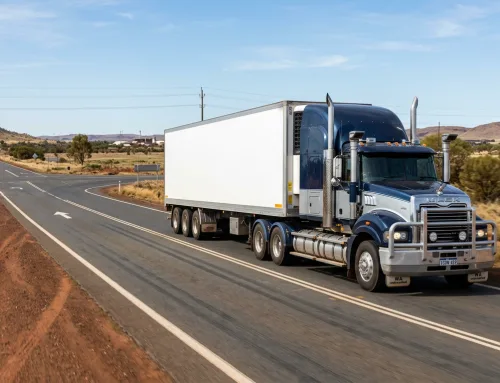
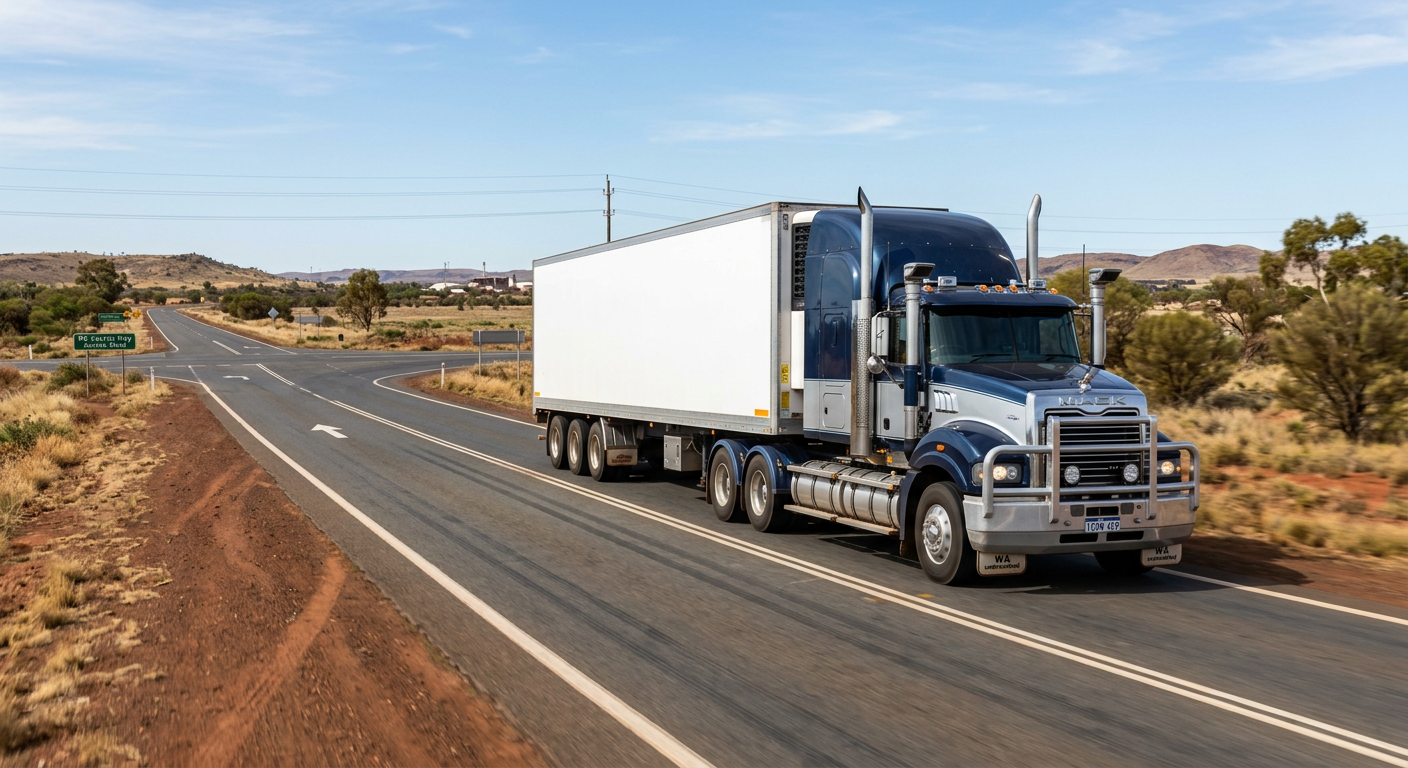
The two central HC configurations are a prime mover with a single attached semi-trailer, and an HR vehicle towing a trailer with a GVM greater than 9,000 kg. Transport WA’s HC licence guidance sets out both arrangements. This makes HC more specific than a general category for a “bigger truck”.
For example, a prime mover with one semi-trailer is an HC configuration, not an HR rigid truck with an ordinary trailer. Likewise, keeping an HR rigid truck but changing its trailer from 9,000 kg GVM to 10,000 kg GVM moves that example beyond the HR trailer allowance. Both examples show why the connection and trailer specification matter.
Why Two Trailers Do Not Automatically Mean MC
HC also permits one additional trailer with a maximum GVM of 9,000 kg behind the attached trailer or semi-trailer. It additionally permits an unladen converter dolly or low loader dolly. These allowances mean that counting trailers alone can give the wrong answer: a permitted HC arrangement can include an additional trailer without automatically becoming MC.
When describing such a combination, identify the main trailer or semi-trailer, the additional trailer and their individual GVMs. If a dolly is involved, include its type and whether it is unladen. This gives the discussion a concrete starting point and avoids treating every second attachment as evidence of the same licence requirement.
Our training at Blue Horse Truck Driver Training is delivered one-to-one. Bring the vehicle description into the course discussion so we can focus on the work you intend to do. An enquiry about a rigid truck and heavy trailer is much clearer when it includes the trailer’s GVM, rather than only a request to move up from HR.
MC: The Multi-Trailer Combination Route
Transport WA’s MC licence guidance covers heavy combination units towing two or more trailers, each with a GVM greater than 9,000 kg. That qualifying arrangement is different from HC’s allowance for an additional trailer of up to 9,000 kg GVM. Both the number of trailers and their GVMs belong in the decision.
B-doubles and road trains are examples of the vehicles covered by MC. Long-distance work or a substantial load, however, is not a useful substitute for describing the combination. Start with the equipment you will operate, then match its configuration to the class. This keeps the decision tied to the vehicle instead of the perceived seniority of the licence.
Match the Class to Your Licence History
For HR, the WA experience requirement is a C-class licence held for at least two years, or an LR or MR licence held for at least one year. You must not be a provisional licence holder. These are entry requirements, separate from deciding whether the intended truck fits the HR vehicle definition.
For HC, you must have held a C-class licence for at least three years and an MR or HR licence for at least one year, and you must not be a provisional licence holder. Holding a car licence for three years alone is therefore insufficient. Both parts of the experience requirement need to be satisfied.
For MC, you must have held a C-class licence for at least three years and an HR or HC licence for at least one year. MR alone does not satisfy the heavy vehicle experience requirement for MC. Equally, the published requirement allows qualifying HR experience; it does not require every applicant to hold HC first.
Our student information brings together licence-upgrade information and student policies. Before discussing dates, put together the classes you hold and how long you have held them. Keeping that history alongside the vehicle description makes it easier to distinguish the course you need from the course you are currently eligible to enter.
Understand the Training and Assessment Route
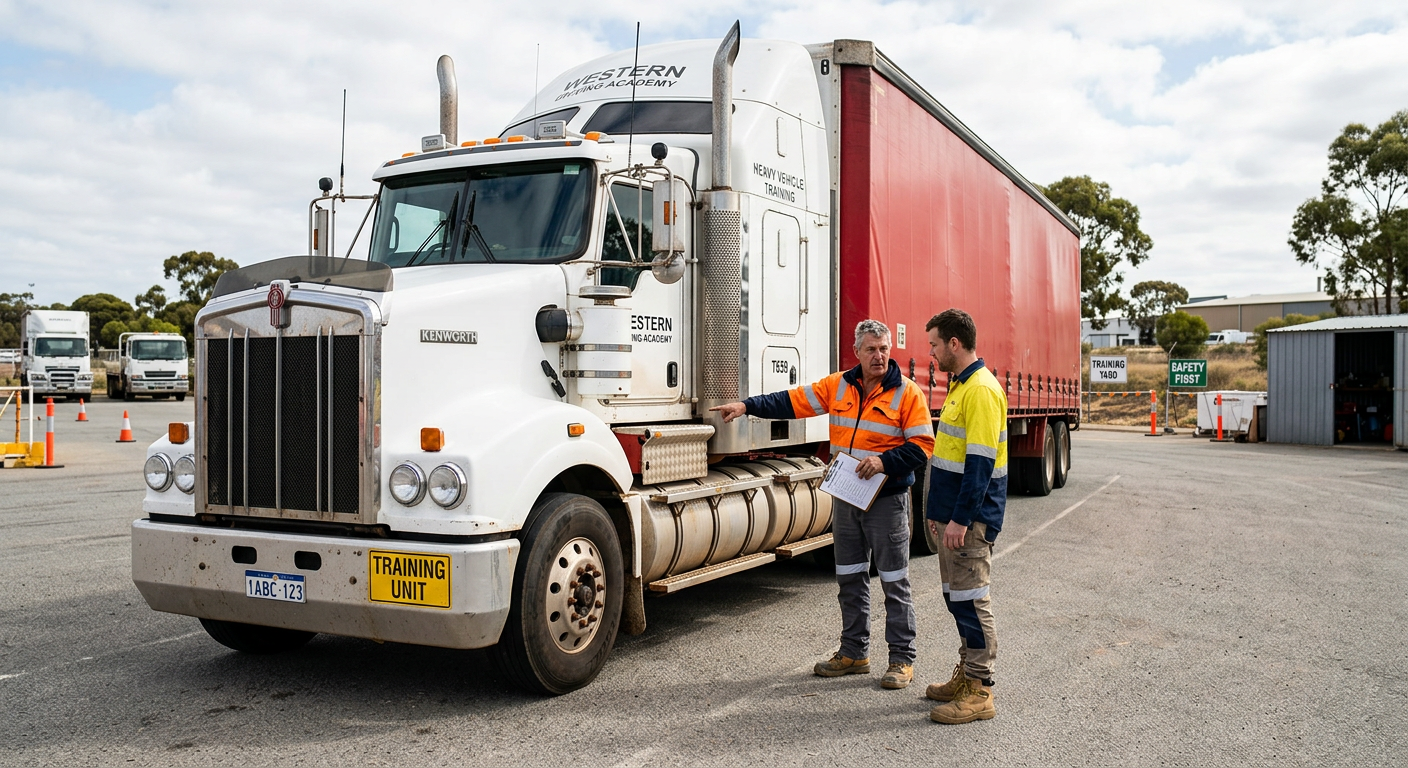
Our HR training covers TLIC3004 Drive heavy rigid vehicles, with online theory and practical assessments and one day of one-to-one training. Successful completion of the unit and issuance of a Statement of Attainment make you eligible to undertake the Department of Transport Practical Driving Assessment, or PDA, conducted by our DoT-approved assessors. The unit assessment and the licensing PDA are distinct steps.
Our HC course covers TLIC3005 Drive heavy combination vehicles and includes two days of one-to-one training. It requires successful completion of online theory and practical assessments for the Statement of Attainment. After successful unit completion and issuance of that statement, you are eligible to undertake the PDA with our DoT-approved assessors.
Our MC course covers TLIC4006 Drive multi-combination vehicle, with online theory and practical assessments and two days of one-to-one training. Successful unit completion and issuance of the Statement of Attainment lead to eligibility for the PDA with our DoT-approved assessors. MC licensing assessments must be completed through an approved registered training organisation.
For training preparation, our course outlines cover safe driving techniques, systematic control of vehicle functions, monitoring traffic and road conditions, managing vehicle condition and performance, and responding to hazards. These are useful areas to consider alongside the class decision: the aim is to develop vehicle-control skills, not simply memorise the names HR, HC and MC.
Under WA’s RTO assessment requirements, we must verify eligibility through the Licence Assessment Provider System. You need to complete and sign the Heavy Vehicle PDA Customer Eligibility form and pass a commercial vehicle eyesight test. Eligibility is checked again on the day of the PDA; an expired licence, for example, makes you ineligible.
Passing the PDA is not the final licensing step. You must then visit a Department of Transport and Major Infrastructure service centre or regional agent to have your licence endorsed. You are not authorised to drive the heavy vehicle until that step is complete. Allow for this when discussing a proposed start date for driving duties.
Make the Choice From the Vehicle You Will Drive
Bring together the intended configuration, rigid vehicle axle count and GVM, trailer details, transmission and your licence history. That gives you a practical basis for choosing a course without relying on labels such as “big truck” or “semi work”. To discuss the appropriate training pathway, contact us with those details and the type of driving work you are preparing for.


Leave A Comment