
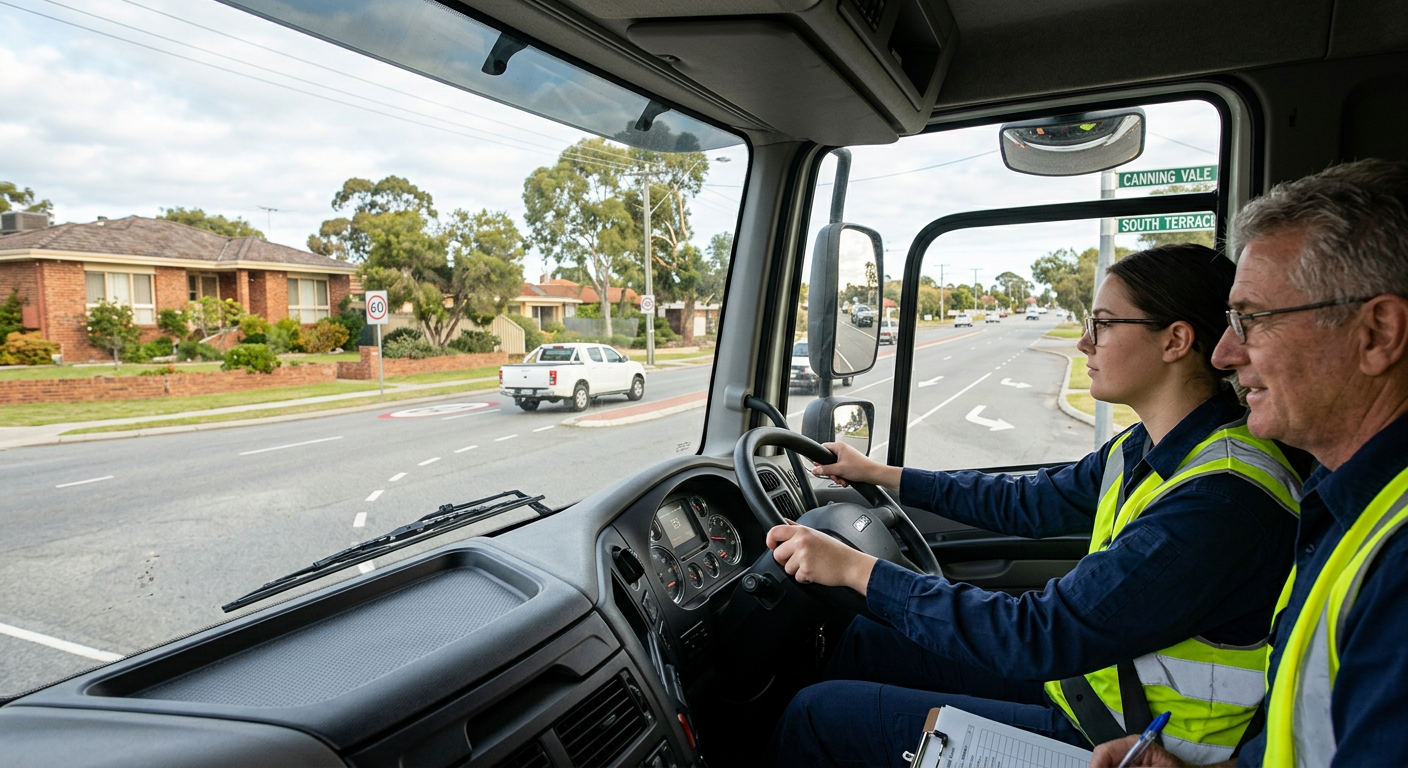
The HR on the pad at 6 Mcelligott Court sits over eight tonnes GVM, and the PDA assessor starts marking the moment a hand hits the door handle. That first walk-up is already part of the Perth truck driving test. Park brake, wheels, mirrors, cabin drill, none of it waits for Bannister Road.
We run the DoT PDA from this yard. The truck you sit in is the truck you trained in. One-on-one on-road hours come first. The assessment is the last site, not a surprise.
The PDA Starts at the Door Handle
An HR practical driving assessment is not a highway cruise with a clipboard in the passenger seat. The assessor is scoring approach, observation and control before the key turns.
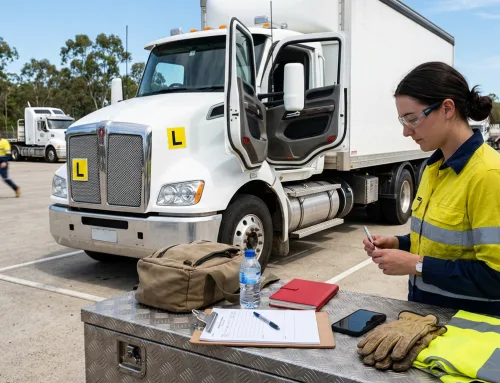
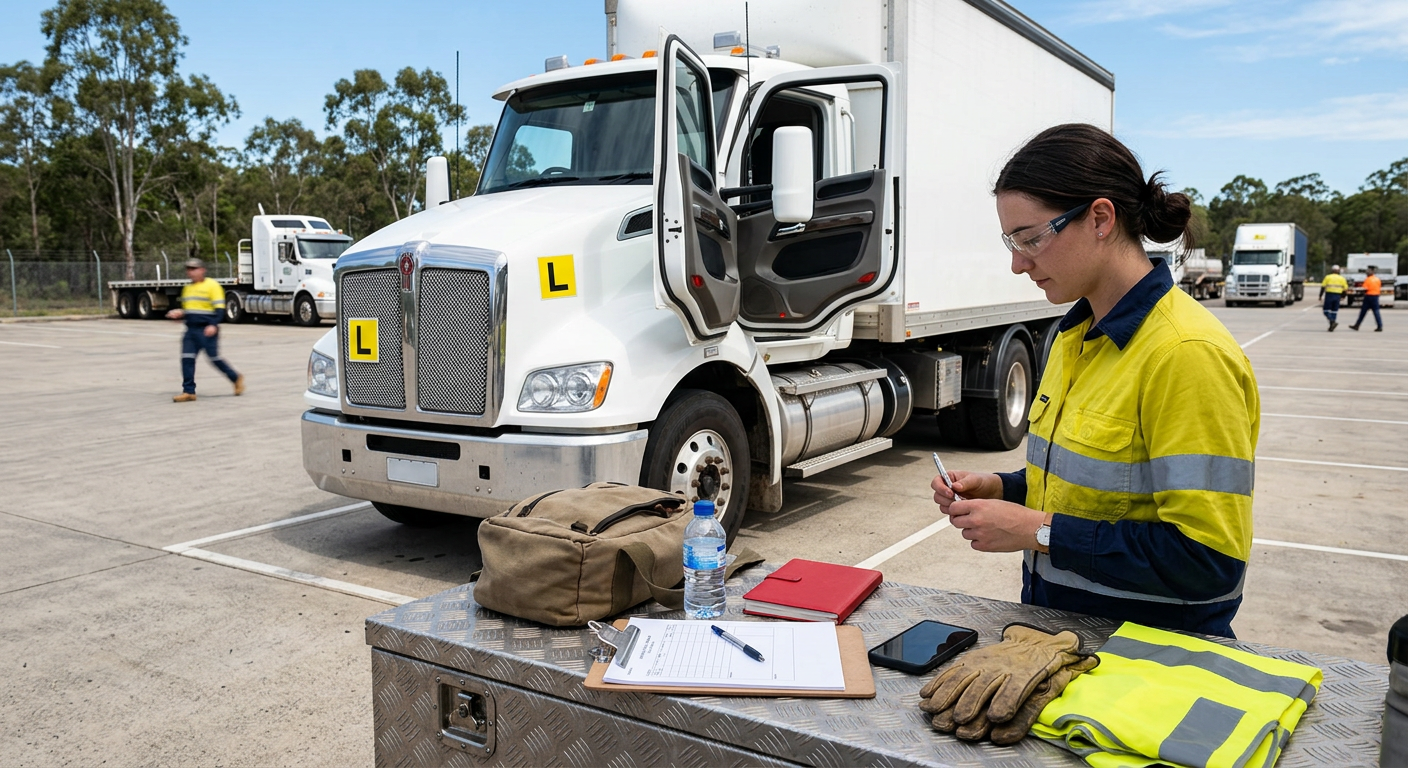
Walk in from the passenger side if that is how we briefed you. Check the ground under the chassis. Look for leaks, loose gear, a chock that should not be there. Touch the tyres with intent, not a glance.
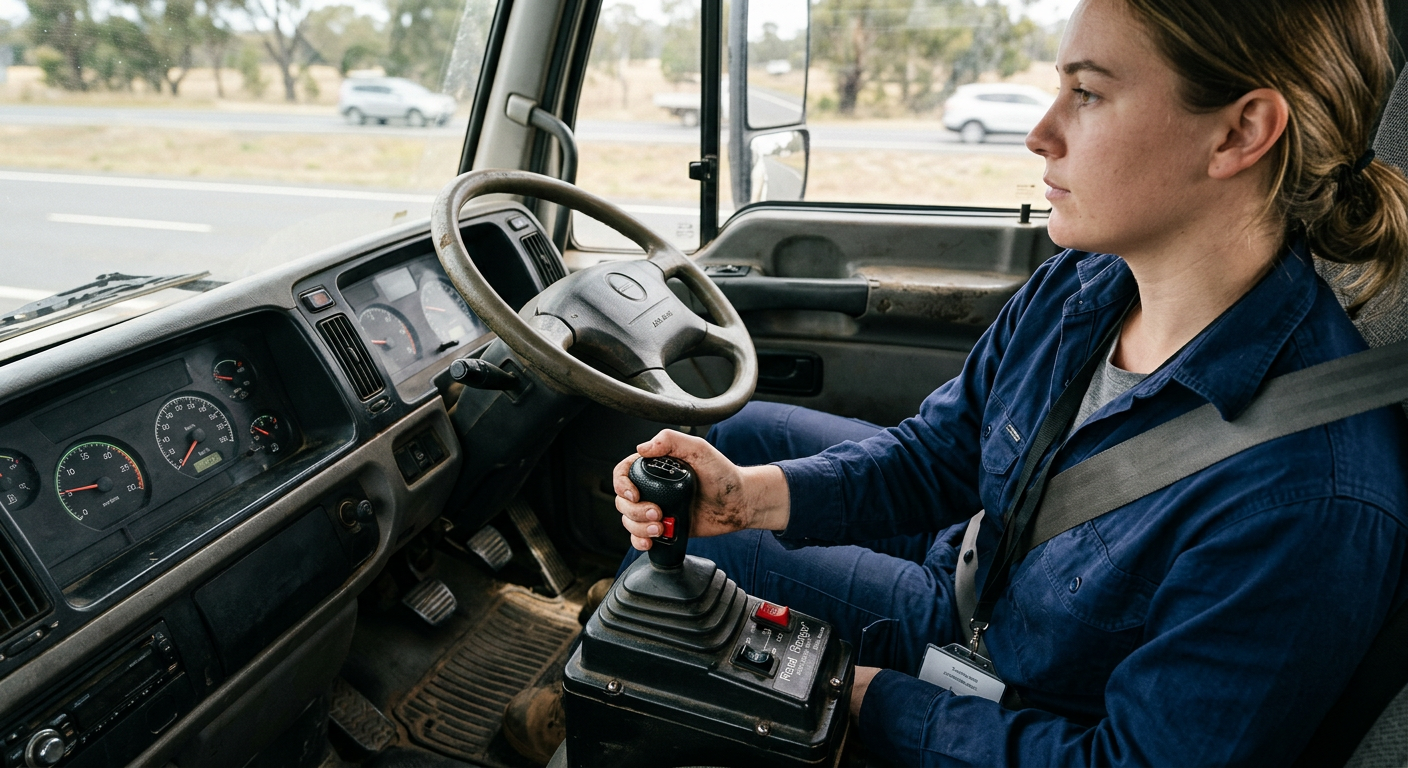
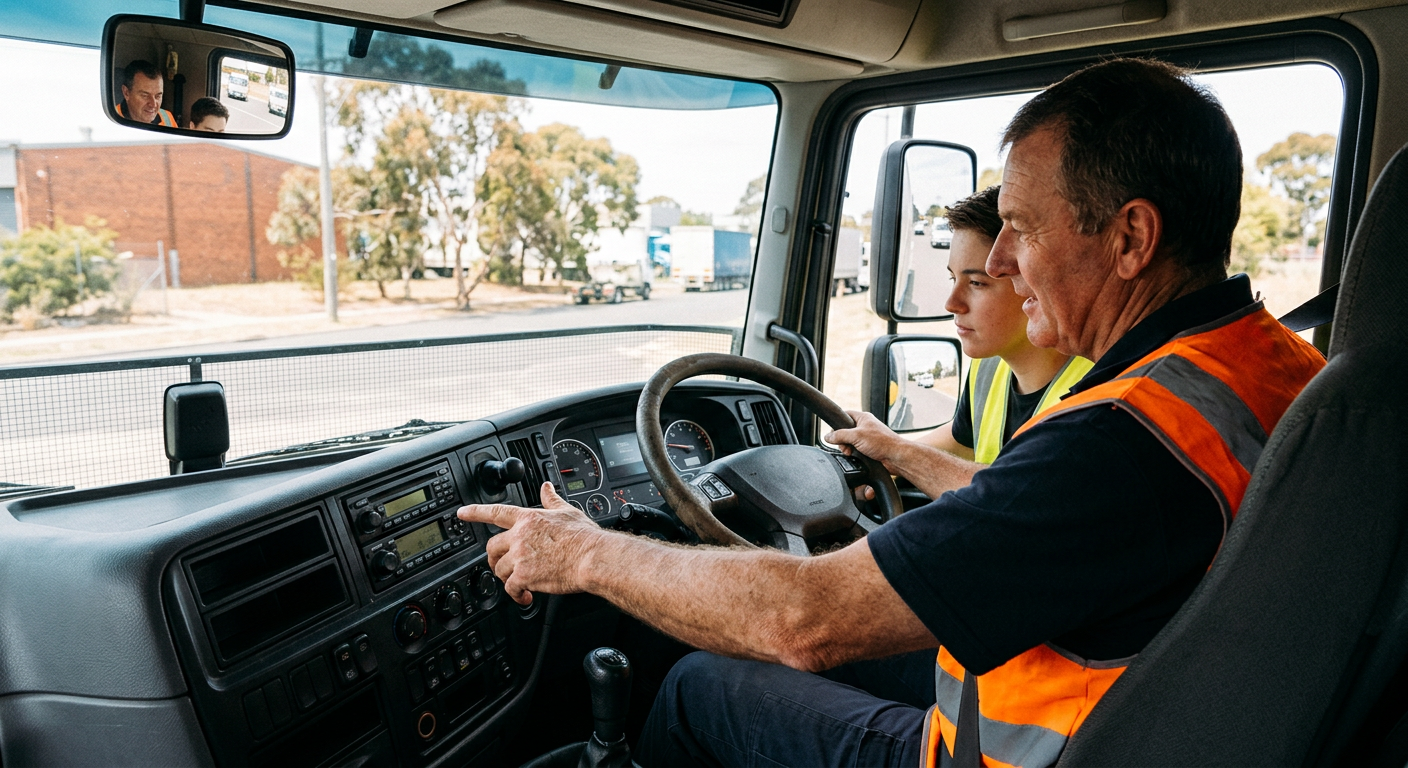
Take time to familiarise yourself with the seat, steering, mirrors, park brake, pedals and gauges, and ask your trainer about checks specific to a Road Ranger.
Give yourself time to work through pre-start checks rather than rushing to get on the road. Learning to monitor vehicle condition is part of HR training, so use your preparation time to ask about any checks you are unsure how to carry out.
Pre-Start and Cabin Drill That Hold Up
Do the same sequence every time. Same order as the last training session. The assessor has seen every shortcut.
Walk the offside first if that is our yard drill. Lights, indicators, reflectors, number plates, air tanks, suspension, couplings if anything is tagged on, load restraint points even on a rigid. Then the nearside. Then under the cab if the tilt is part of that HR.
In the Seat Park Brake on Gearbox
In the seat: park brake on, gearbox in neutral, clutch down if it is a manual, ignition on, gauges live, low air warning if fitted, wipers, horn, washers. Adjust the seat so you can bury the clutch without stretching. Set both external mirrors and the kerb mirror before you look at the assessor.
If the HR is auto, still treat the selector like a gearbox. Park, then drive, then a full stop before reverse. Do not flick it.
A sloppy cabin drill writes the first faults on the sheet. Those faults sit there for the rest of the Perth truck driving test.
Road Ranger, Synchromesh or Auto on Assessment Day
Say which box you are sitting before we lock the PDA date. Auto, synchromesh or Road Ranger are not interchangeable on the day.
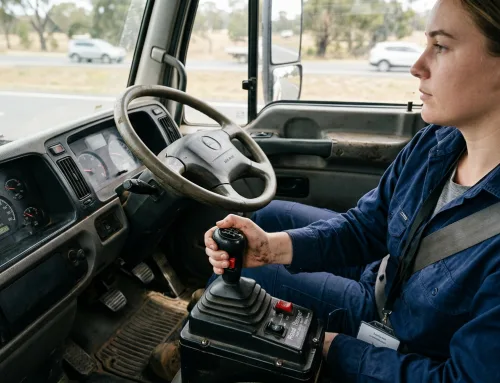
Road Ranger wants a clean double-declutch and a split that matches road speed. If you float a gate or grind a range change in the first kilometre, the assessor is already writing. Practice the same pattern we used on the last on-road hour: start in the gear that moves the GVM without labouring, up through the box without looking down, split only when the tacho asks for it.
Synchromesh Still Needs a Full Stop Into
Synchromesh still needs a full stop into reverse and a pause before first. Do not treat it like a car.
Auto is not a free pass. Smooth take-up, no roll-back on a grade, correct use of the retarder or exhaust brake if that HR has one, and a dead stop before you select reverse. Coasting in neutral is a fault in any box.
We will not put you in a Road Ranger PDA if your hours were all auto. Match the training to the sit. That is the point of the one-on-one hours.
GVM, Mirrors and the HR You Will Sit
Read the GVM plate in the cab. Say the number. Know the length and width of that rigid. The assessor can ask. Guessing is a fault.
Mirrors run the test. Left kerb, right offside, centre if fitted. Check them before every move off the line, before every lane change, before every reverse. A head check still matters. Mirrors alone are not enough at junctions.
Blind Spots on an HR Are Not
Blind spots on an HR are not car blind spots. A car can sit beside the drive axle and disappear. We drill that on the yard and on the road. On PDA day you demonstrate it without being asked.
Know where the front overhang goes in a left turn. Know how far the tail swings on a right. Canning Vale industrial streets punish a wide line. So do the residential corners we use on the route.
If you cannot place the nearside wheel on a mark in the yard, you are not ready for the on-road reverse or the controlled stop. Tell us. We put more hours in before we book the assessor.
On-Road Marking on a Perth Truck Driving Test
Speed is marked against the sign and the conditions, not against the car in front. An HR at 60 in a 50 is a fault. An HR at 50 in a 60 with a queue behind is also marked if you are holding traffic without a reason.
Allow more room to merge in an HR than you would in a car. Use your one-on-one training with Blue Horse Truck Driver Training to practise judging gaps and planning lane changes before a turn. Do not pinch a cyclist on the nearside or cut a car off on the offside because you wanted the next lane.
Roundabouts in This Part of Perth Are
Roundabouts in this part of Perth are where PDAs die. Enter in the correct lane. Hold the lane. Exit without straddling. Indicate with enough time for the vehicle behind to read it. Cancel the indicator.
Railway crossings, school zones, pedestrian crossings, full procedure. Mirrors, speed, ready to stop. Do not roll a crossing on a late amber.
The controlled stop is a marked exercise. Smooth, straight, the correct distance from the kerb, park brake, gearbox. Then move off without roll-back and without a stall if it is a manual HR practical driving assessment.
Reversing: the assessor will put you into a bay or a line. Mirrors, idle, clutch control or brake control, no kerb strike, no cone. Stop when you should stop. Do not keep rolling to “fix” a line.
Use your on-road training time to work on gear changes and positioning through turns. Book more heavy rigid licence training if you still need practice changing gears or keeping a safe line through a left turn.
TLIC3004, Logbooks and the Paper the Assessor Asks For
TLIC3004 sits under the HR outcome. The PDA is the driving assessment. The unit evidence is the rest of the file.
Bring the licence you actually hold. A C class that is current. Any heavy restriction already printed on it. Glasses if the licence says glasses. The assessor will check.
Work diary rules apply once you are in the industry. For the PDA, bring what we told you to bring: identification, licence, any booking confirmation, and the medical if Transport has asked for one. Do not arrive with a phone full of screenshots and nothing in the wallet.
Read the student driving information before booking to check the licence eligibility requirements and understand what happens if you defer your PDA. Confirm what documents you need to bring before assessment day.
Confirm the HR licence requirements with Transport WA before planning your assessment. HR covers rigid vehicles with three or more axles and a GVM over 8 tonnes, and allows a trailer up to 9 tonnes GVM. A prime mover with a single semi-trailer falls under HC, while MC covers multi-combination vehicles; those courses involve different training units.
We keep the RTO file at 52853. You keep your own copies. If Transport queries the outcome, you need the same dates we have.
Canning Vale Yard, Routes and Site Conditions
6 Mcelligott Court is a working yard. Other trucks move. Forks move. Do not wander through a live lane to find the amenities. Stay where we put you until the assessor calls you on.
The surface changes after rain. Painted lines get slick. The HR will push on a wet painted island the same way it does on a wet roundabout. We train that. On PDA day you drive it, you do not explain it.
Wind across the open pad moves an empty rigid more than students expect. Hold the wheel. Do not correct late and big.
The route leaves the industrial estate and picks up mixed traffic. Expect 50 and 60 zones, multi-lane, a reverse, a hill start if the assessor wants one, and at least one junction where a car will try to dive up the inside.
Yard condition in summer: cab heat, glare on the bonnet, mirrors that need a wipe before you roll. Do the wipe. It is part of the cabin drill.
Yard condition in winter: wet steps, wet grab handles, fogged glass. Demist before you move. Moving with a fogged screen is a fault.
The Week Before You Book or Sit
Sleep. Eat. Do not turn up for three hours and a coffee. An HR practical driving assessment runs longer than a car test. Fatigue shows in the box and in the mirrors.
Drive the last training hour like the PDA. Same sequence, same commentary, same speed discipline. If that hour is messy, we do not book the assessor for the next morning. We book another hour.
Know the truck. Which side the park brake is on. Where the trailer air would be if this were a combination, even though it is not, the assessor can ask what you would check. Where the extinguisher is. Where the triangles are.
Wear boots you can feel the pedals in. No thongs. No slippery city soul. High-vis if we said high-vis for the yard.
Phone off and in the bag. Not silent in the cup holder. The assessor is not interested in a notification during a reverse.
If you are sick, call. A PDA seat with a fever is a wasted fee and a dirty sheet. We would rather move the date than write you up for faults that are really a headache.
After the Assessor Signs the Sheet
A pass means the sheet is signed and the next step is Transport, not a lap of honour around the estate. We will tell you exactly what to take to the licensing centre and in what order. Do not guess. Do not post the sheet on a group chat and ask strangers.
A fail is a list of faults, not a character assessment. Read the sheet with us in the yard before you leave. We will point at the items that are training items and the items that were one bad decision on a roundabout. Then we book the hours that fix those items. Then we book the next PDA.
Do not change the gearbox type between a fail and a resist unless we agree to it. Switching from Road Ranger to auto to “make it easier” only works if the hours match.
HC and MC come later. TLIC3005 and TLIC4006 are different units, different GVM, coupling, and a different PDA. Get the HR clean first. A messy HR sit does not become a clean HC sit.
The next useful thing is simple. If the last on-road hour was clean and the documents are in the wallet, lock the PDA date with us and treat the next seven days like the sit already started. If the last hour still had a missed mirror or a late indicator, book the hour first. The assessor will still be standing at that door handle either way.
Before arranging your HR practical driving assessment, note any gear changes, mirror checks or turn positioning that still need practice. Bring those points into a discussion about your preparation when you contact us to arrange further training in Canning Vale.
Leave A Comment