
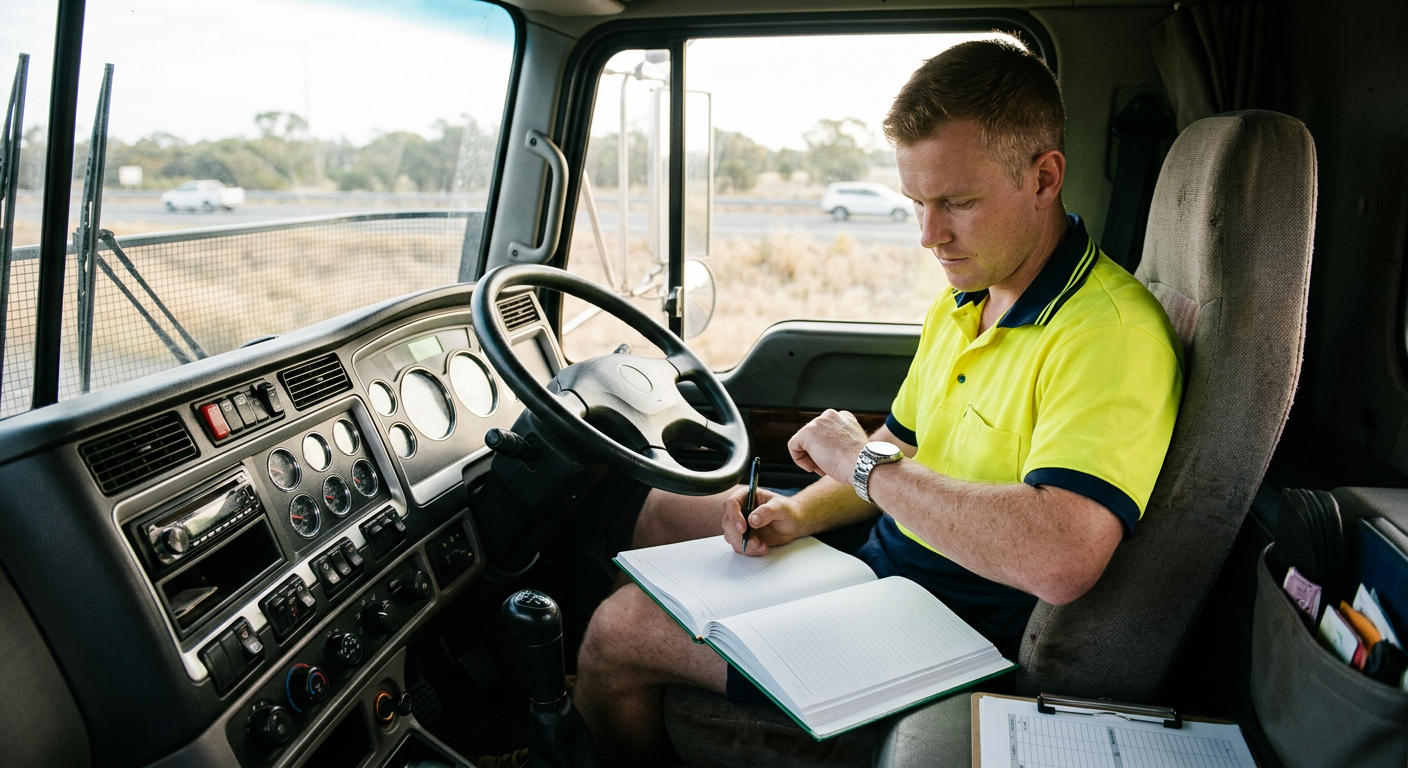
A new heavy-vehicle licence can open up new types of work, but the licence class is only one part of your preparation. An HR, HC or MC licence label does not by itself answer the diary question. The vehicle, where you will drive and the fatigue-management hours applying to the work all matter.
For new drivers researching National Driver Work Diary WA information, the important distinction is between work within Western Australia and driving outside Western Australia and the Northern Territory. Do not treat a national diary as an automatic consequence of upgrading your licence, or assume that every interstate journey has the same requirements.
We recommend separating your preparation into two parts: establishing what your licence permits you to drive, and understanding the work and rest recording arrangements for the proposed job. Keep both parts in the same trip-planning notes, but give each its own heading so that a licensing answer does not become a diary assumption.
This guide explains the main diary conditions and how to prepare for using the official instructions. It is not an individual trip determination or a complete guide to fatigue obligations for WA-only work. Its purpose is to help you identify the relevant details before your first unfamiliar assignment.
Read the Conditions Together
Transport WA’s guidance says you must carry and complete a National Driver Work Diary when driving a vehicle or vehicle combination weighing more than 12 tonnes, or a bus fitted to carry more than 12 adults including the driver, and driving outside Western Australia and the Northern Territory. The vehicle condition and geographical condition belong together.
That geographical distinction matters for a driver based in WA. Work entirely within WA is different from entering a jurisdiction where the national fatigue framework applies. However, the national diary wording is not a blanket exemption from fatigue management or other record-keeping obligations for local work. Keep the question “Do I need a national diary?” separate from “What fatigue and recording arrangements apply to this job?”
Write a plain description of the proposed assignment before trying to resolve the heavy vehicle work diary requirements. Include the vehicle or combination, its relevant weight information, any bus seating capacity, the states or territories on the route, the nominated driver base and the hours arrangement. This gives an employer or regulator a concrete situation to address, instead of an ambiguous description such as “a long run in a big truck”.
Separate Vehicle Class From Diary Conditions
HR, HC and MC describe different vehicle classes. Transport WA describes an HR vehicle as having three or more axles and a gross vehicle mass greater than 8,000 kg. Its HR licence information also permits towing a trailer with a maximum GVM of 9,000 kg. Those licence figures should not be substituted for the separate national diary threshold.
For HC, the permitted vehicles include a prime mover with an attached single semi-trailer, or an HR vehicle with an attached trailer having a GVM greater than 9,000 kg. MC covers a heavy combination unit towing two or more trailers, each with a GVM greater than 9,000 kg. These descriptions explain licence scope; they do not replace the diary conditions concerning location, vehicle and operating hours.
A change to the assignment can make your earlier preparation incomplete. If the vehicle changes from a rigid truck to a combination, or the route extends beyond WA and the NT, revisit the relevant diary information with those changed facts in front of you. Keep the revised assignment details together so that advice about the original job is not accidentally carried over to the new one.
Understand the 100-Kilometre Distinction
Under the NHVR’s work diary guidance, drivers operating under standard hours must use a work diary when working more than 100 kilometres from their base. This is not a universal rule that every driver inside that distance can apply to every operating arrangement. Establishing the hours arrangement is part of understanding the distance condition.
The NHVR requires a diary regardless of distance from base for drivers operating under Basic Fatigue Management, Advanced Fatigue Management, Alternative Compliance Hours under ACA-Fatigue, or exemption hours under a work and rest hours exemption permit or notice. A short-distance assignment does not remove that diary requirement. Include the actual hours arrangement in your work discussion, not just the destination or approximate length of the shift.
Know Which Base You Are Using
Transport WA states that if your driver base is not recorded, the base will be taken to be the garaged address of the regulated heavy vehicle. That makes the base a specific detail to settle, not a casual reference to wherever you happen to start that morning. Put the nominated base alongside your route information so that the distance discussion has an identifiable starting point.
Connect Licence Preparation With Diary Preparation
Our one-on-one HR, HC and MC training at Blue Horse Truck Driver Training addresses the driving side of preparing for a heavy vehicle role. Completing driving instruction does not, by itself, settle which diary arrangements apply to an assignment. Treat the proposed job as the connection between the two: identify the vehicle you need to learn to handle, then use its route, base and hours arrangement to work through the official diary guidance. That gives your preparation a practical focus without treating a training booking as a diary-compliance decision.
Prepare to Record Work and Rest
The National Driver Work Diary is evidence of a driver’s work and rest hours, not simply a record of kilometres travelled. The NHVR’s instructions cover definitions, legal recording requirements, daily sheets, counting time and work and rest hour options. Understanding those elements matters before you try to interpret a completed example or reproduce an entry from somebody else’s diary.
A useful preparation exercise is to read an official worked example with an unused sheet beside it. Identify where the example records work, where it records rest and which instructions explain the entries. Follow one example through from start to finish, noting how its entries relate to the activities described. Write any uncertainty as a specific question about the example, keeping practice notes separate from your actual work records.
Detailed recording instructions are in the front pages of the written diary. The NHVR also directs drivers to its downloadable guide and says drivers can seek assistance from the NHVR, their employer or a more experienced driver. Use those resources to resolve the particular entry you do not understand, rather than copying a colleague’s pattern without understanding what it represents.
Use Guidance That Reflects the 2026 Changes
The NHVR identifies changes to written work diary recording from 1 August 2026 and warns that transitional arrangements can involve different rules operating side by side for a fixed period. Its current guidance links to the written diary changes information sheet and new FAQs. An older handout may therefore be incomplete even when it looks familiar and professionally prepared.
Keep the publication date and the relevant operating arrangement with any instructions you save. In particular, do not lift record-carrying or submission periods out of an old example and apply them to every situation. Use the current information for the record type and circumstances involved. This keeps the focus on the instruction that applies, without turning every preparation session into a search through unrelated rules.
Arrange a Written Diary Before It Is Needed
Transport WA lists metropolitan DTMI service centres and regional agents as places to buy a written National Work Diary. It also states that a diary can only be issued to the driver and that a third party cannot collect it for you. Build your own collection into the preparation timetable instead of assuming that an employer or family member can pick it up.
Treat obtaining the diary and learning to use it as separate tasks. Set aside time to read its instructions after collection, with the relevant official examples available beside you. If an entry remains unclear, identify the page or example involved when seeking help. This gives the person assisting you a precise recording question to work through before the assignment begins.
Identify the Record Type
The NHVR lists a written work diary, an electronic work diary and a local area record among its record types. That list is not permission to choose whichever format seems easiest for a particular shift. Start with the requirement applying to your work, then use the instructions for the relevant record. The standard-hours distance condition and the diary requirements for other hours arrangements still need to be understood before selecting a recording method.
When an employer refers to “the log book”, establish which record they mean before practising an entry. For a written diary, use its front-page instructions alongside the current official examples. If the workplace uses an electronic diary or a local area record, identify the guidance for that arrangement instead of assuming a paper example answers every recording question. This makes the preparation practical: you are learning the record you expect to use, not just becoming familiar with the term “work diary”.
Finish With an Assignment-Specific Plan
For the vehicle-handling part of a new role, our HR training covers vehicle control, monitoring traffic and road conditions, managing vehicle condition and responding to hazards. These are concrete learning areas to consider when preparing to drive an unfamiliar heavy rigid vehicle.
Before the assignment, put its vehicle, route, driver base and hours arrangement together in one brief. Use those details to establish the applicable recording arrangements, then resolve any uncertainty about entries through the current official instructions or the NHVR. For practical driving training alongside that preparation, speak with us about learning to handle the vehicle class involved.
Leave A Comment