
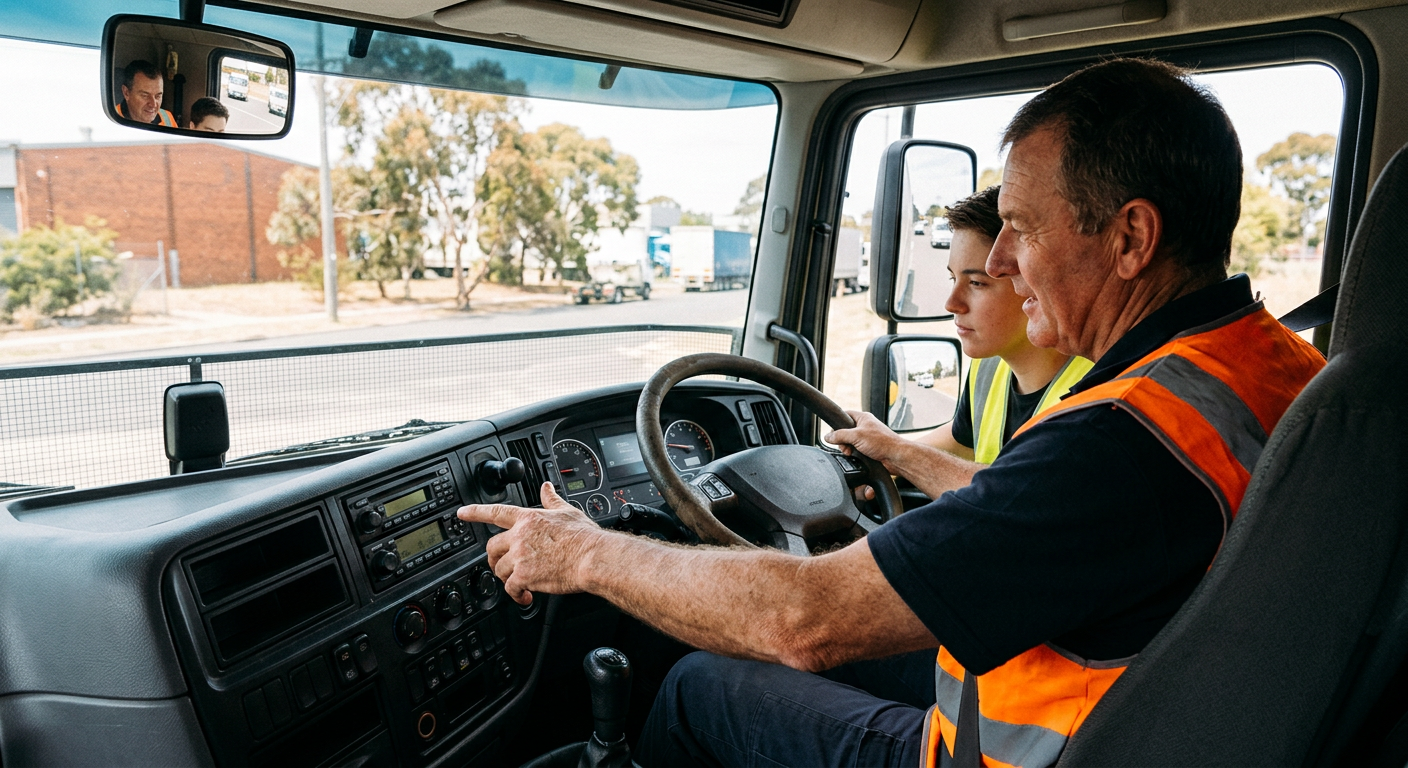
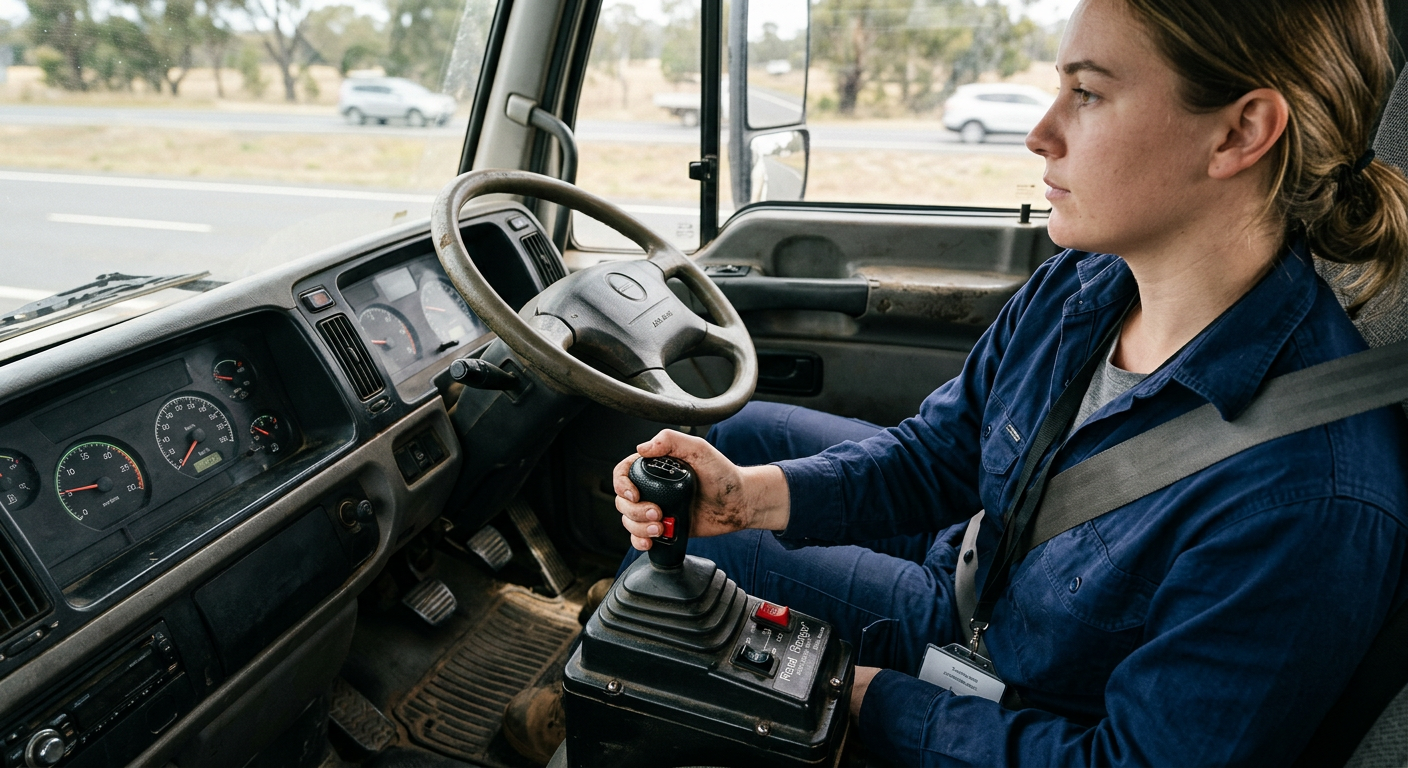
We start TLIC3004 with a calm first hour in the cab so you settle before we roll. We walk through seats, mirrors, pedals and dash as a team. Our trainers talk you through the pre-start from the driver’s seat, not a whiteboard. We check controls together and name every switch we will use on the range. We keep the radio quiet until you find park brakes and indicators without looking down. That first hour builds the habit we need now.
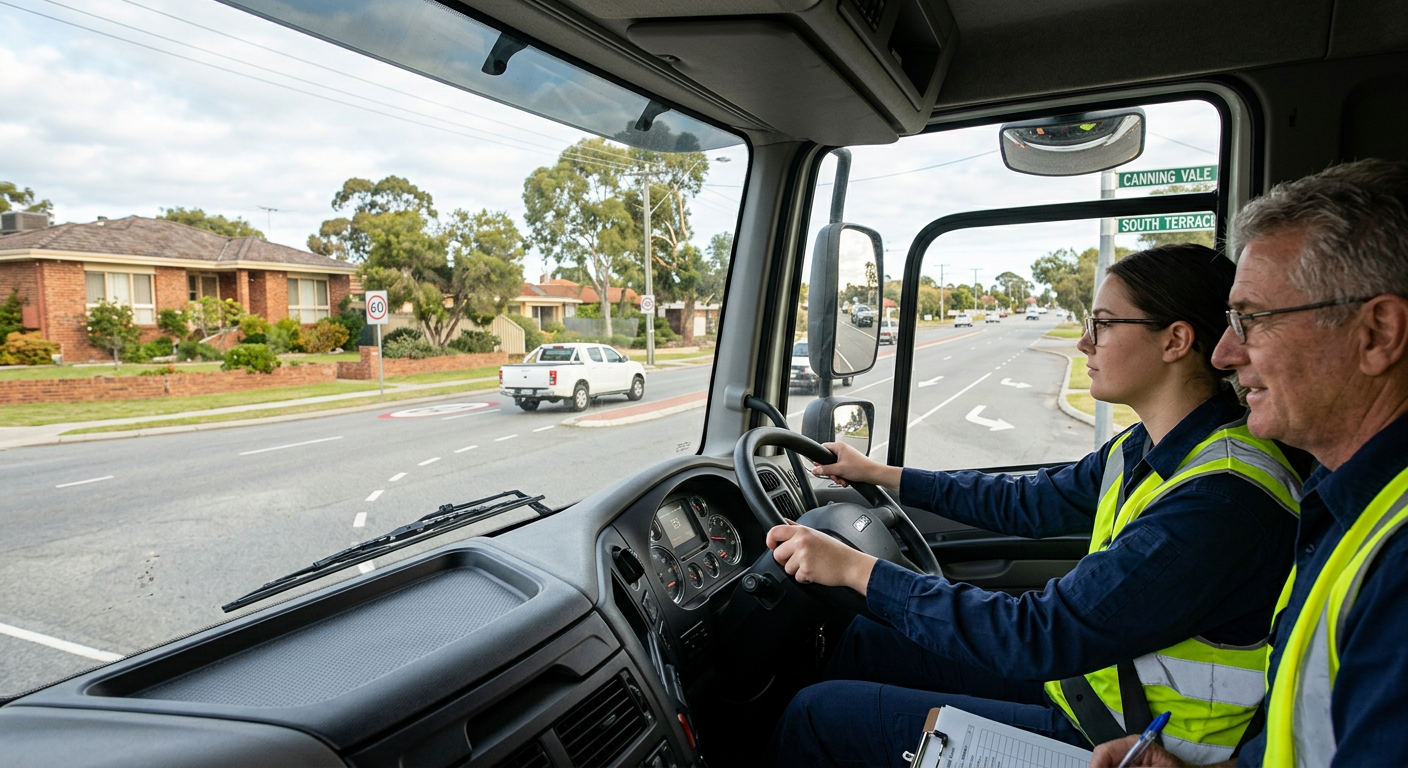
You will sit in the right seat. I will sit on the left. The session is one-on-one. There is no second student in the bunk, no group briefing in a classroom while the truck idles outside. TLIC3004 training is the unit that sits under Heavy Rigid, and heavy rigid course expectations start with the truck in front of you, not a slideshow.
The First Hour in the HR Cab
We do not roll the wheels in the first twenty minutes. The cabin drill comes first. Mirrors, seat, steering lock, park brake, clutch free play if you are on the Road Ranger, range inhibitor, splitter, and the dash lamps that must go out before we treat the truck as live.
You will set the seat so your heel stays planted when the clutch is on the floor. That is not a comfort note. It is how you keep the gearbox alive through a four-hour block. If the seat is too far forward you will ride the clutch on every downchange. If it is too far back you will lose the bite point on a hill start at the yard gate.
Take time to understand the air gauges and the low-air buzzer and identify each control before using it. Ask your instructor to explain any unfamiliar controls before you begin driving.
The cab can feel tall, and the blind spots may be wider than those in the truck you drove before. Ask your trainer to help you understand what you can and cannot see from the driving position.
Pre-Start, Walk-Around and Cabin Drill
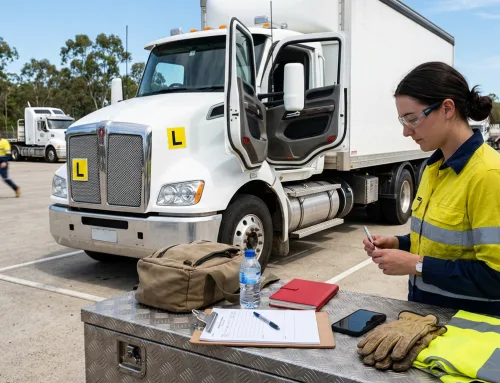
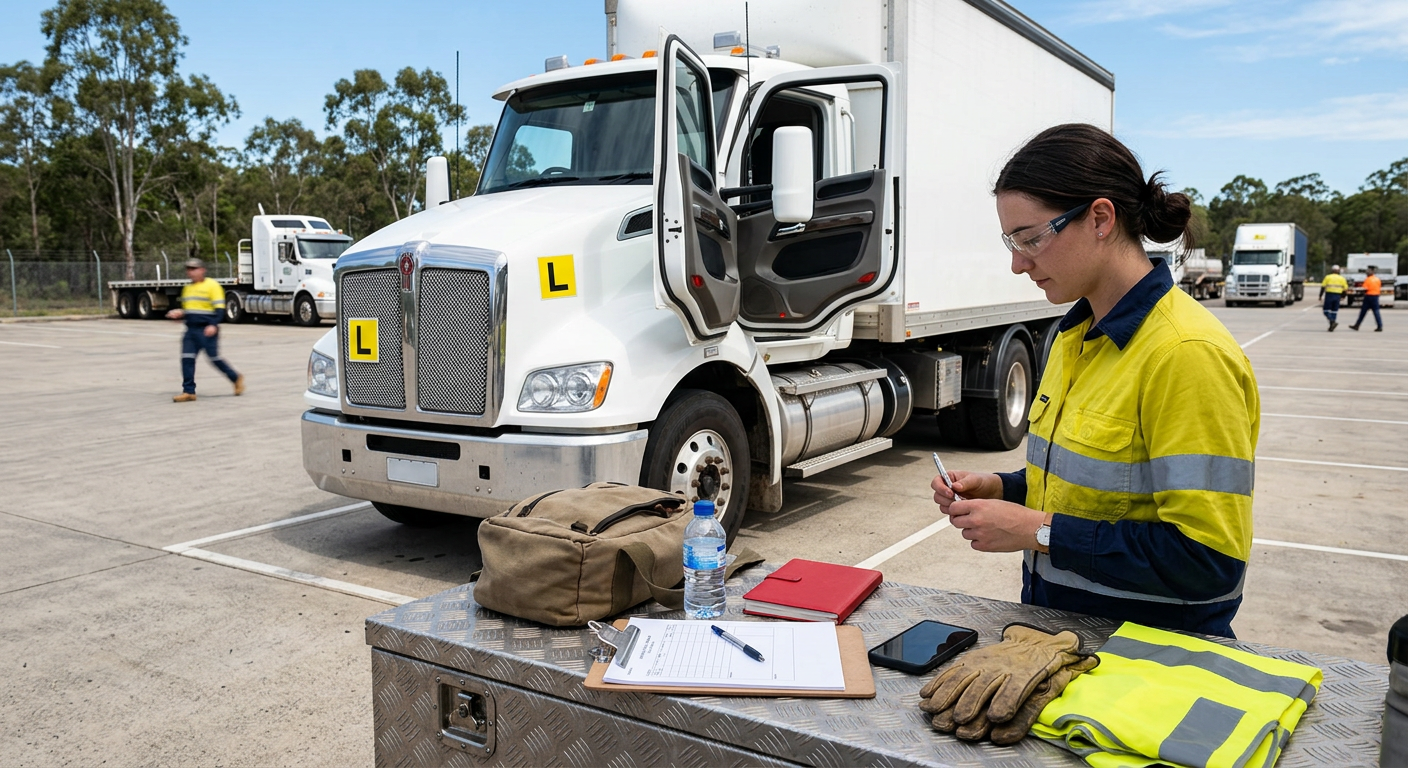
Pre-start is not a tick sheet we rush so we can get on the road. You walk the truck with me. Lights, lenses, wheel nuts, push the sidewalls, look under for weep, check the fifth-wheel area even though this is a rigid, because the habit has to be in place before you ever sit an HC unit.
You will open the fuel caps, check the coolant, oil, and AdBlue if the truck carries it. You will look at the load restraint points even on an empty tray. TLIC3004 asks you to prepare a heavy rigid for the road. The assessor on PDA day will watch the same walk-around.
Cabin drill follows the walk-around. Ignition, wait for the glow or the self-check, build air, release park only when I say. You do not select a gear until the air is up. That rule does not change because you already drive a work ute.
We run the same pre-start sequence every session. By the third morning you should be able to do it without me prompting the next item. That is one of the cleaner heavy rigid course expectations: the walk-around becomes yours, not mine.
Road Ranger and Auto Paths Through TLIC3004
TLIC3004 is the same unit whether you sit in an auto or Road Ranger. The competence is still preparing, driving, and shutting down a heavy rig. The gearbox is the path, not the unit.
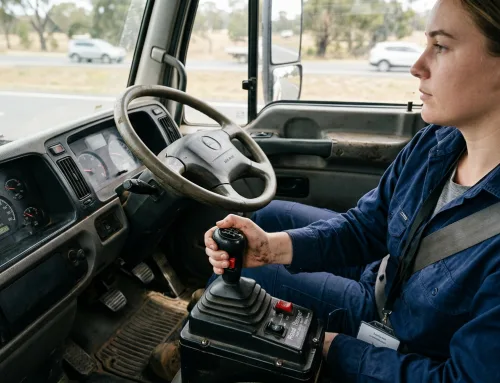
If you book Road Ranger, the first on-road hour is slow. Range change, splitter, and the gate. You will miss a gate. Everyone who has never held a non-synchro stick misses a gate. We stop, we put it in neutral, we start again. I will not talk about the mistake. I will tell you what the box did and what your hand did.
If you book auto, we still treat gear selection as a decision. You will hold a gear on a descent. You will not let the box hunt on a roundabout. Auto is not a free ride through TLIC3004 training. The PDA still wants a smooth, legal, planned drive.
We run both paths from the same Canning Vale yard. The truck you train in is the class of truck you will sit the PDA in. We do not switch you into a different gearbox on test morning.
On-Road Hours and What We Actually Practise
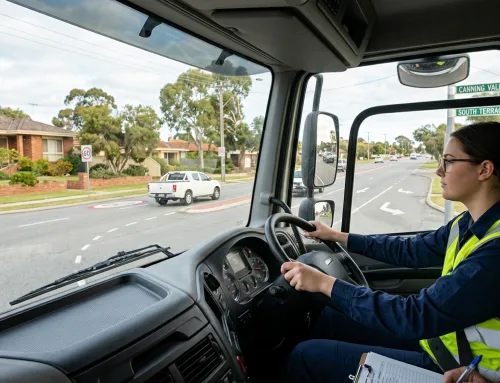
One-on-one on-road training is the core of the session. We leave 6 Mcelligott Court and we work a mix of industrial, arterial, and a stretch of open road so you see the HR at speed and at crawl.
You will practise:
Gap Selection at Lights With a Long
- gap selection at lights with a long wheelbase
- left turns without climbing the kerb or cutting the car in the next lane
- roundabouts in a vehicle that needs the whole lane
- downhill control with the engine brake
- a reverse into a marked bay that is tighter than it looks from the ground
- a hill start that does not roll and does not dump the clutch
I will call the next task before the current one finishes. That is how the PDA feels. The assessor will not wait for you to ask what comes next. Heavy rigid course expectations include thinking one intersection ahead while you still have a gear to pick.
We stop if the drive gets ragged. A sloppy ten minutes taught again is worth more than an hour of surviving the traffic. TLIC3004 training is not a sightseeing lap of Perth.
Work Diary Entries You Will Write That Day
If you are already in the industry, or you are heading there, the work diary sits on the dash from the first paid kilometre. We treat the training day the same way.
You will write a start time, a location, and a finish. You will record the rest we take. You will not invent a break you did not take. The diary is evidence. It is also the habit that keeps you legal once the licence is in the wallet.
I will show you how we record a training day so it does not collide with a later work shift. Fatigue rules do not pause because the session is a course. If you arrived already close to your limit, we reschedule. We do not squeeze TLIC3004 into a day that is already full.
Bring the diary if you have one. Ask your Blue Horse Truck Driver Training instructor about fatigue management during training and how to account for any work shifts around your session.
GVM, Mass and Why the Plate Matters
Heavy Rigid is a class, not a vibe. The plate on the door is the number that decides whether the truck in front of you is even legal for the licence you are sitting on.
We read the GVM together. We talk about GCM only enough to stop you confusing the two. We talk about what you can tow on HR and what you cannot. That conversation is short and specific, because the next class up is a different unit and a different truck.
Before you decide the licence is the right step, consider whether TLIC3004 covers the driving skills you need for the truck you will use at work. The unit concerns driving a heavy rigid vehicle; you also need to check that the licence class suits that truck.
If your employer’s rigid sits under the HR threshold, say so on day one. We will not pretend TLIC3004 is the right unit if the job only needs a lighter class. If the job is already an HR, we train to that GVM and that length.
How the DoT PDA Is Run at the Yard
The Practical Driving Assessment is DoT. It is not a school test we invent. We run the PDA on site at Canning Vale. You will know the truck. You will know the yard. You will not know the exact route the assessor picks that morning.
PDA morning looks like this. Pre-start. Cabin drill. A drive that covers the competencies in TLIC3004. A reverse. A shutdown. The assessor is looking for a safe, legal, planned drive in a heavy rig. They are not looking for a perfect Road Ranger symphony. They will fail a dangerous gap, a rolled hill start, or a cabin drill you cannot complete without being told.
We do not sit you for PDA on the first hour of the first day. TLIC3004 training sessions exist so the PDA is a demonstration, not a discovery. If you are not ready, we say so and we book more hours. That is a better outcome than a failure on a day you already took off work.
You will hear the same language in training that you will hear from the assessor. Mirror, signal, gap, speed, position. We do not invent private code.
Fatigue, Rest Breaks and Session Length
A typical TLIC3004 block with us is a long morning or a full day, not a forty-minute lesson. You will get a rest. You will get out of the cab. You will drink water. You will not eat a heavy meal and then try a Road Ranger hill start.
I watch your shoulders and your feet. When the clutch foot starts to slap, we park. When the commentary dries up, we park. Fatigue in an HR is not a theory unit. It is the reason the last ten minutes of a session can undo the first two hours.
Tell Me If You Slept Badly Tell
Tell me if you slept badly. Tell me if you are on a night roster. We will set the start time around a body that can still learn. Heavy rigid course expectations include turning up fit enough to take information. They do not include pretending you are fine.
What the Second Session Should Feel Like
By the second TLIC3004 training session the walk-around should be yours. The cabin drill should be shorter. The first kilometre should be quieter.
We spend that day on the things that still wobble. For Road Ranger that is usually the downchange into a corner and the range change under load. For auto that is usually speed control into a roundabout and the decision to hold a gear on a descent.
I will talk less. You will talk more. Commentary driving is part of the unit. You name the hazard, the plan, and the gear. If you cannot say it, you do not yet own it.
Reverses get tighter. We will put you into a bay that punishes a wide swing. We will not let you collect a post and laugh it off. The tray has a tail swing. You will learn where it goes by watching it, not by hoping.
What to Bring and What Stays in the Truck
Bring your current licence, your eyes, and boots you can feel the pedals through. Bring water. Bring the work diary if you have one. Bring any medical or licence conditions we need to plan around.
We supply the HR, the fuel, the yard, and the assessor booking when you are ready. You do not need to bring a high-vis if we are staying in the cab and the yard, but wear one if you will be on the ground around other trucks.
Leave the phone in the bag. There is no film of the session for socials. There is no passenger filming your first miss on the Road Ranger. The cab is a workplace for those hours.
Before you arrive for heavy rigid licence training, familiarise yourself with TLIC3004 and the transmission you have chosen: automatic, synchromesh or Road Ranger. Knowing those terms can make the discussion about your truck and gearbox easier on day one.
How TLIC3004 Sits Against HC and MC
TLIC3004 is Heavy Rigid. It is not HC. It is not MC. Coupling a trailer is not the job of this unit. If your next truck at work is a prime mover and a trailer, say that on the booking call. We will still run TLIC3004 properly, then we will talk TLIC3005 and TLIC4006 as separate units with their own trucks and their own PDAs.
Do not treat HR as a shortcut into a B-double. The class you sit in is the class you hold. The skills transfer. The licence does not.
Students who already know they need HC often still sit HR first because the rigid hours clean up the cab habits before a prime mover arrives. That is a planning choice, not a rule. We will not push you up to a class you do not need.
Booking the Hours and Sitting the Unit
Check course pricing before you ring so you can discuss dates, your gearbox choice and the cost of training. Automatic, synchromesh and Road Ranger courses have different prices. Additional lessons are available if you need more practice, so allow for that possibility when planning your budget.
Call with three facts: the gearbox you want, the date you can take a full block, and whether you are booking training only or training plus the DoT PDA on site. We will put you in the HR that matches the path.
If you are sitting TLIC3004 because a job starts on a Monday, tell us the Monday. We will not invent a faster unit. We will tell you whether the hours you have left are enough to be ready, or whether the honest move is a later PDA and a conversation with the employer.
Turn up for the first session as if the PDA is that afternoon. Pre-start starts at the gate, not after a coffee and a story. The GVM plate will still be on the door. The stick, or the auto gate, will still be where we left it. We will start there.
To plan your TLIC3004 training in Canning Vale, speak with us about your gearbox choice, available dates and whether you need training alone or training with an on-site PDA.
Leave A Comment