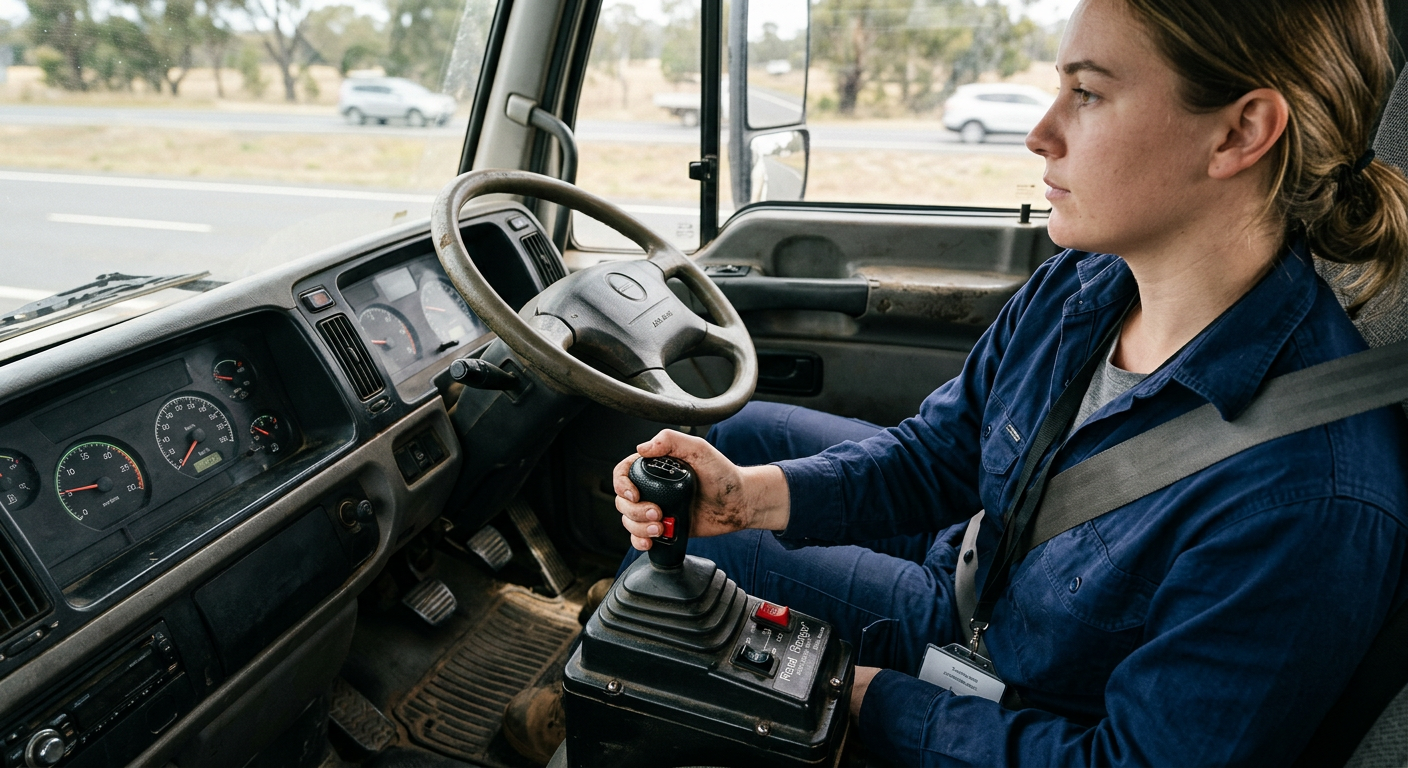
The Road Ranger in this HR sits tall in the doghouse, the stick has that long throw, and the first missed gate on our Canning Vale yard sends a clunk through the chassis that you feel in your boots. No synchro is going to catch a lazy shift. That is the whole lesson in one noise.
You booked HR Road Ranger training because the auto ticket will not cover the work you want. Fair. The gearbox is the reason people stall in this class, not the steering or the mirrors. Sit still for a minute before we roll. Learn what the box is asking for, then the rest of the cab starts to make sense.
Why This Box Has No Forgiveness
A Road Ranger is a non-synchromesh transmission. Fuller-style. The gears are sliding dogs, not the baulk-ring setup you grew up with in a car or a light synchro truck. If shaft speeds do not match, the dogs will not mesh. Force it and you grind. Hold it and you sit in neutral while traffic stacks up behind you.
That is not a character test. It is physics. Our job in the cab is to get your feet, ears and right hand working on the same clock so the dogs slide home without a fight.
HR work around Perth still uses these boxes in older fleets and on construction and livestock gear. If the work you want involves a Road Ranger, learn the non-synchro pattern as part of your HR training. Moving into heavy combination training is a separate licence decision, based on whether you need to drive a prime mover with a single semi-trailer or an HR vehicle towing a trailer over 9,000 kg GVM.
The stick can feel vague at first. You are not looking for a car-like notch. You are finding a gate by feel, then confirming it with engine note and road speed. If you later move into multi-combination training, check which transmission you will be using rather than expecting the same shift pattern.
The H-Pattern, the Range, and What Your Left Hand Is Actually Doing
Most of the HR Road Rangers we put students in are 13-speed or 18-speed layouts. Low range and high range share the same H. A range button or selector on the stick flips the box between those two worlds. Some have a splitter as well, so each gate can be half-stepped.
Forget memorising a poster on the visor. Watch road speed and tacho, then put the stick where those two numbers live.
Low Range First Second Third Fourth Is
Low range first, second, third, fourth is your yard and your crawl. High range is the road. Splitters fill the gaps when the load or the hill asks for a half gear you do not have in a simple 9-speed.
Keep your palm on the knob, not a death grip. Thumb finds the range button without looking down. Eyes stay on the lane. The second you stare at the stick, the truck starts to wander and the assessor writes it down.
Neutral is a real place. You will spend time there on every shift. Do not treat it like a pause you have to rush through.
Clutch Travel, the Clutch Brake, and Why Your Left Foot Is the Whole Game
Push the pedal to the floor when the truck is stopped and you will feel the clutch brake come in at the bottom. That stops the input shaft so you can select first or reverse from rest without grinding. Use it only from a standstill. If you stab the clutch brake on the move you will chew the brake and the box will hate you.
For moving shifts, you only need enough clutch to break engine drive. That is not floor-it every time. A lot of new students ride the pedal halfway and wonder why the revs will not settle. Heel on the floor, ball of the foot on the pedal, clean in and clean out.
Rev matching is the skill. Upshift: clutch in, stick to neutral, clutch out, let the revs drop to the next gear, clutch in, next gate, clutch out. Downshift: same idea with a blip in neutral so the engine comes up to the lower gear.
Some drivers float the shift and barely use the clutch once the truck is rolling. We will get there. First you double-clutch until the timing lives in your feet. Floating a missed gate is how students write off a synchro they do not even have.
Hearing the Engine Instead of Watching the Needle
The tacho is a check, not a crutch. After a few laps of the yard you should hear the note that says this gear is done. On our trucks that is often around the 1,600 to 1,800 mark on an upshift under light load, lower if you are empty and just wanting to progress.
Labouring the engine in a tall gear on a rise is how you stall in front of a DoT officer. If the note goes dull and the truck stops accelerating, you needed the split or the downshift ten metres ago.
Empty HR on a flat Canning Vale street will pull taller gears than the same truck with a loaded body. GVM is not a sticker you glance at in the pre-start. It is why the same shift that worked this morning will not work after the tipper is full.
Listen, then shift. If you wait for the needle to tell you, you are already late.
Pre-Start and Cabin Drill Before the Stick Even Moves
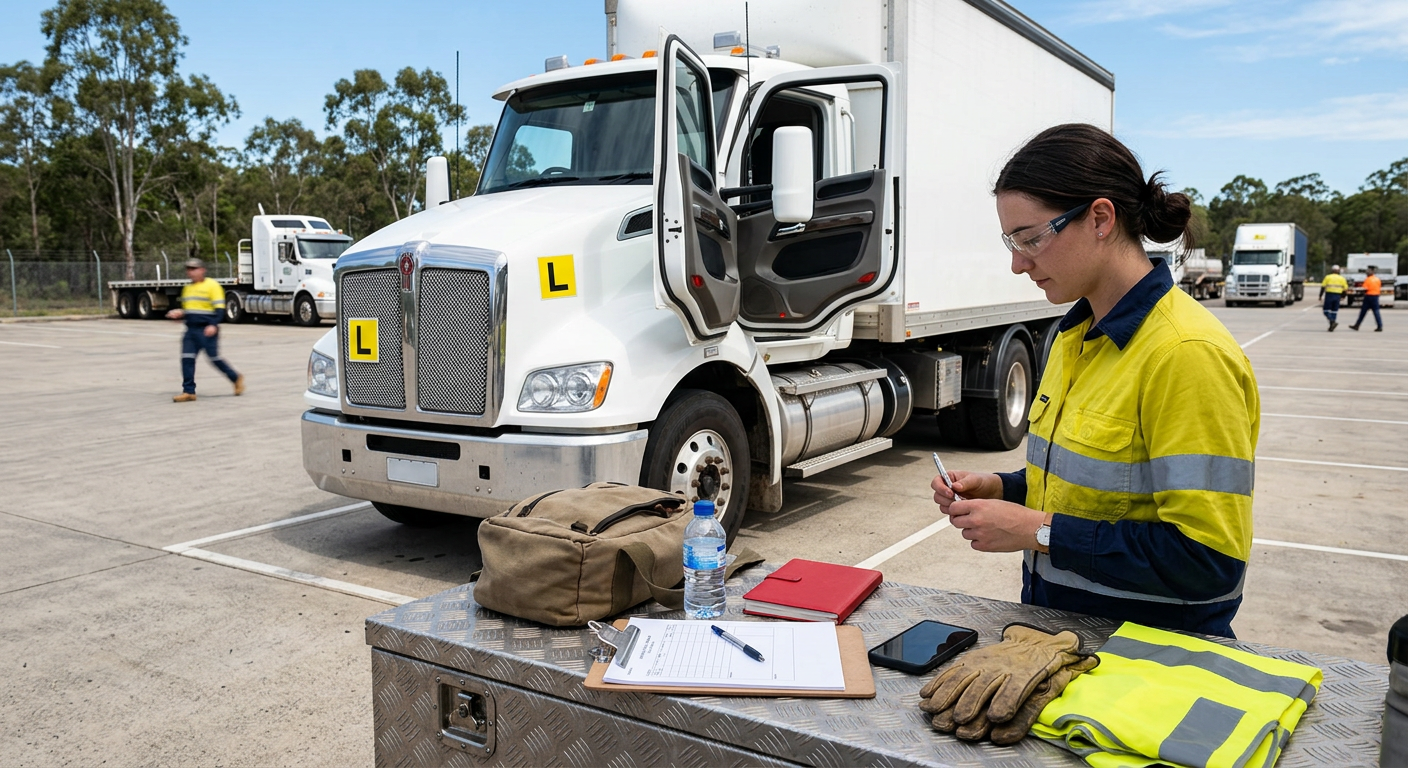
We do not roll until the walk-around is done. Oils, water, belts, leaks under the box, pushrod travel, lights, wheels, load restraint if there is a body on. Road Ranger training fails in the first five minutes when a student jumps in and grabs the key.
Cabin drill is the same every time. Seat, mirrors, steering lock, pedals where your feet naturally sit, park brake feel, range selector position, and where first actually lives in this truck. Not the last truck. This one.
Confirm the Box Is in Neutral Before
Confirm the box is in neutral before you crank. A Road Ranger left in gear will lurch or refuse to start depending on how the clutch is set. That lurch in a yard full of other students is how people get hurt.
Work through the dash warnings. Know which ones are park-brake related and which ones mean you do not leave the bay.
If you want the unit mapped against the national criteria before you sit, read Transport WA and bring the performance evidence list with you. We train to that document, not to a vibe.
Yard Circuits That Actually Teach the Shift
First session is not the freeway. It is our yard, first to second, stop, reverse into a bay, clutch brake, first again. Then a figure-eight that forces you to change range at a speed you can think through.
We will put a cone line out so you have to look up. If your eyes drop to the stick, the cone gets hit. That is the point.
Once First to Second Is Clean We
Once first-to-second is clean, we add third and the range changes. The range change is where most new students stall the learning. You must be in neutral, or in the last low-range gear depending on the box, before you flip the selector. Flip it under load and nothing happens, or you get a nasty partial engagement.
Count it out loud for the first hour if you have to. “Clutch, neutral, range, clutch, gate.” Then stop counting and do it.
Reverse is its own skill. Clutch brake, select reverse, idle out, do not dump. An HR with a body has a blind side that will punish a rushed reverse more than the gearbox will.
On-Road Habits That Survive a DoT PDA
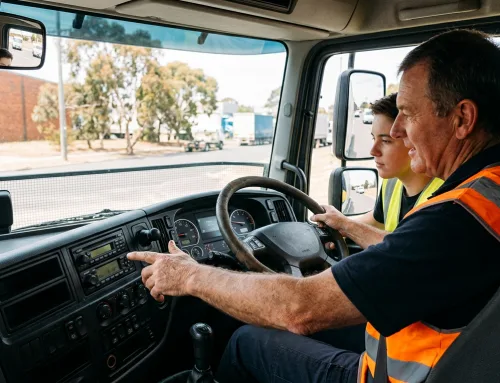
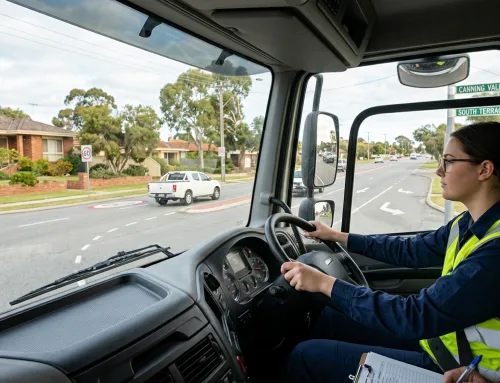
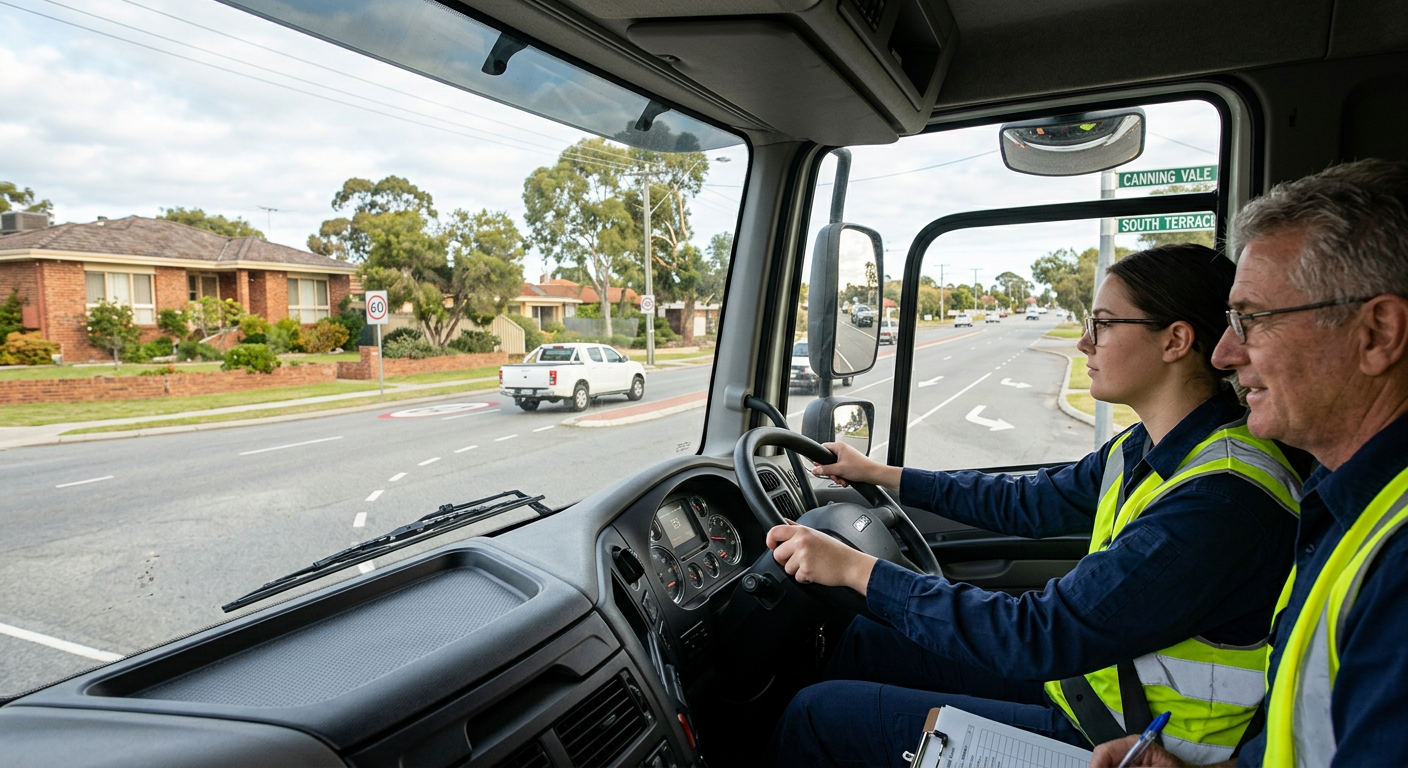
The PDA is not a separate driving style. Build steady driving habits during practice rather than saving them for assessment day. Our one-on-one on-road training at Blue Horse Truck Driver Training gives you the instructor’s attention while you practise coordinating gear changes with the traffic and road conditions.
Roundabouts are where Road Ranger students lose the plot. You enter in a gear that will pull you through without a shift in the circle if you can help it. Shifting mid-roundabout with a trailer-length of truck behind the steer axle is how lines go wide.
Hills Set the Gear Before the Grade
Hills: set the gear before the grade. A late downshift on a rise, with a loaded GVM, is a stall. Early downshift on a descent, using the engine as a brake, keeps the service brakes cool. You will be asked to demonstrate that.
Traffic lights: plan the stop so you are not grabbing neutral at 40 km/h and coasting. Select the restart gear as you come to rest, clutch brake if you need it, and be ready. An assessor watches the gap you leave and the gear you choose, not just whether the truck moved.
Mirrors every shift. The box can wait half a second. The bike in your left blind spot cannot HR Road Ranger training. HR Road Ranger training. HR Road Ranger training. HR Road Ranger training.
When you are ready to book heavy rigid licence training, bring the same questions you asked in the cab. Specify Road Ranger training when discussing your booking, because HR training is also offered in automatic and synchromesh vehicles.
Common Misses We Correct in the First Two Hours
Looking at the stick. Every time. Eyes up.
Riding the clutch on the yard crawl. Heel down, pedal out once the truck is moving in that gear.
Forcing a gate that is not ready. Neutral, match revs, try again. A grind is information, not a dare.
Flipping range while the stick is still in a gear. Neutral first.
Starting in too high a gear because it first felt embarrassing. First is first. The truck is heavy. GVM does not care about your pride.
Forgetting the clutch brake from rest, then blaming the box.
Over-revving before an upshift so the next gear slams in. Match, do not launch.
Going silent. Talk the shift until it is automatic. I would rather hear you mutter “blip, third” than watch you guess.
None of those are character flaws. They are the standard first-day list. We fix them in the seat, not in a classroom slideshow.
GVM, Load and Why the Same Truck Changes Personality
An empty HR in our yard is a different animal to the same truck near GVM with a loaded body. Stopping distances stretch. The box needs more revs to pull the next gear. Downshifts come earlier.
Read the plate. Know what we are sitting at today. If the assessment truck is loaded differently to the training truck, your shift points will move. That is not a trick. That is the job.
Coupling is not an HR task in the same way it is for HC, but bodies, cranes and tailgates still change weight distribution. Walk around. Look at the tires. Feel how the truck sits before you pick first.
Speed choice is a GVM choice. The Road Ranger will let you sit in a tall gear and drone. The road and the assessor will not.
Work Diary, Rest and the Paper That Sits Next to the Licence
Even as a student you treat time on the road like work. If you already hold a light rigid or you are moving toward HC later, start the diary habit now. False entries and blank pages are how people lose tickets they just paid for.
Keep the booking confirmation, the log of hours, and any medicals in the same folder as your learner log. PDA day is not when you want to discover a document is at home.
We sit the DoT PDA from the Canning Vale yard at 6 Mcelligott Court. Same trucks, same cabin drill, same pre-start you have already done a dozen times. The officer is watching the standard, not our banter.
Before you put a deposit down, ask about the experience of our trainers and how additional lessons could help with the shifts you find difficult. Our trainers are DoT-accredited and TAE certified, with real-life heavy vehicle experience.
How We Structure the Hours So the PDA Is Not a Surprise
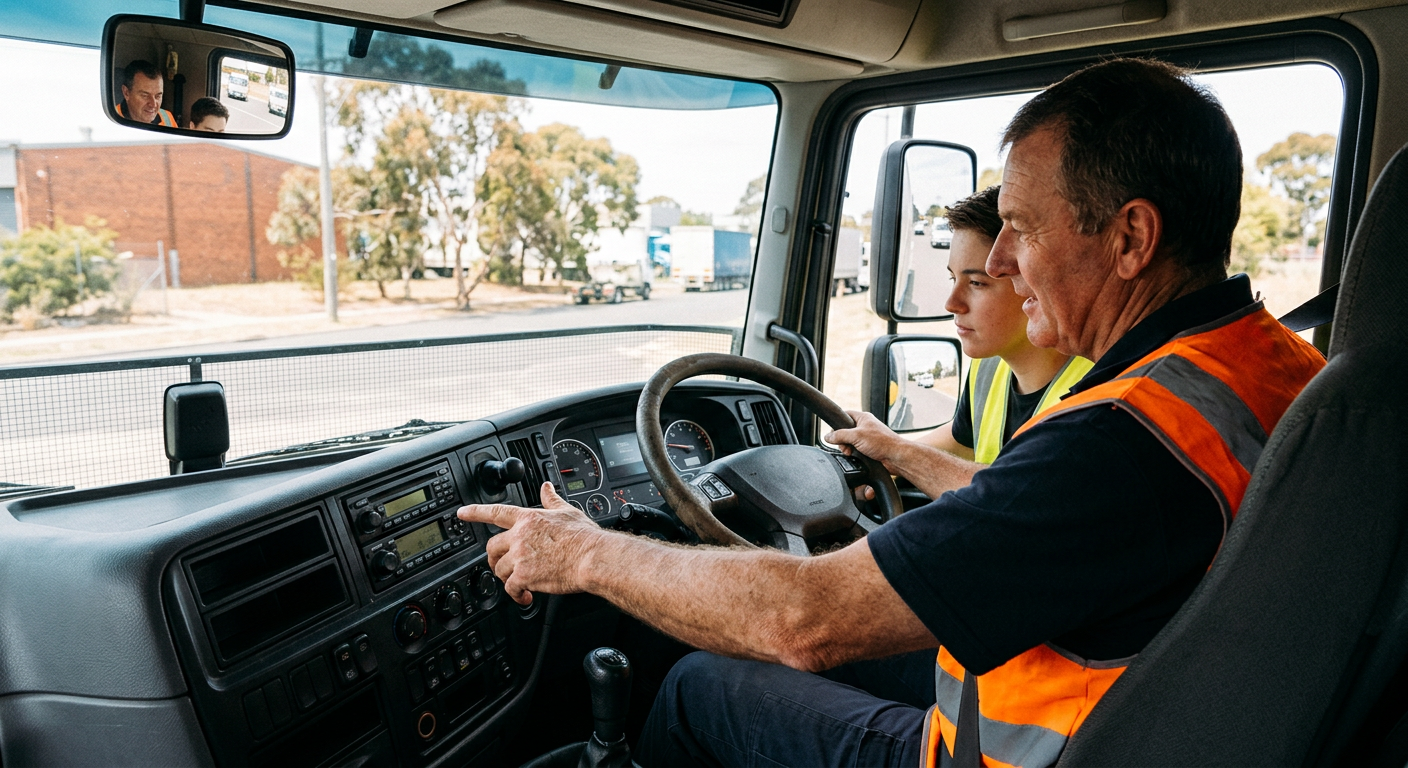
One-on-one means I am not splitting attention across a group in the sleeper. You get the stick, I get the commentary. We stop when a shift is dirty and we do that corner again.
Early hours are yard and light roads. Mid hours add traffic, hills and range work under a bit of load. Late hours are PDA routes, fault-finding, and the boring stuff: head checks, indicator timing, gap selection, and a clean pre-start you can do while talking.
If a session ends and first-to-second is still messy, we do not pretend the freeway will fix it. We book the next block around that fault. That is how you actually learn Road Ranger Perth roads will throw at you, not how you collect hours.
Auto HR is a valid path for some work. Stay with the non-synchro until the dogs go in quiet. Then decide if you ever want the auto as a second string.
What to Do the Night Before a Session
Sleep. A tired left foot is a late clutch.
Wear boots you can feel the pedal through. Gym shoes hide travel.
Eat something. Low blood sugar makes people rush gates.
Read your last session notes. If I wrote “range too early on the South Street on-ramp,” that is the first thing we drill.
Do not watch an hour of American 18-speed videos and then climb into our 13-speed expecting the same splitter rhythm. Patterns differ. This truck is the syllabus.
Bring your licence, your booking, and any glasses you need for the PDA. We cannot start if the paperwork is wrong.
Sitting the Unit and the One Next Step That Matters
TLIC3004 is a heavy rigid vehicle. The assessment is competence, not a vibe that you “got the hang of it.” You will pre-start, cabin-drill, move off, shift through the range, reverse, manage traffic, and shut down. The Road Ranger is only one part. A clean box and a dirty head-check still fails.
If a shift goes wrong on assessment day, recover. Neutral, match, select, move. Panic-grinding three gates in a row is what gets written up. One recovery that you talk through is often survivable. Three silent messes are not.
After you hold the HR, the next useful decision is whether your work needs HC. That is a different unit, a different coupling drill, and a different GVM conversation. Do not skip straight to a prime mover in your head while first gear is still a coin toss.
Book the next cab session while the last one is still in your feet. Two weeks off and the clutch brake timing fades. Send the date you can, tell us whether you want the same truck, and we will put you back in the seat on a Road Ranger until the gates are boring. That is the whole job.
To discuss your next Road Ranger lesson in Canning Vale, speak with us about the gear changes you want to practise and the dates you can attend.
Leave A Comment