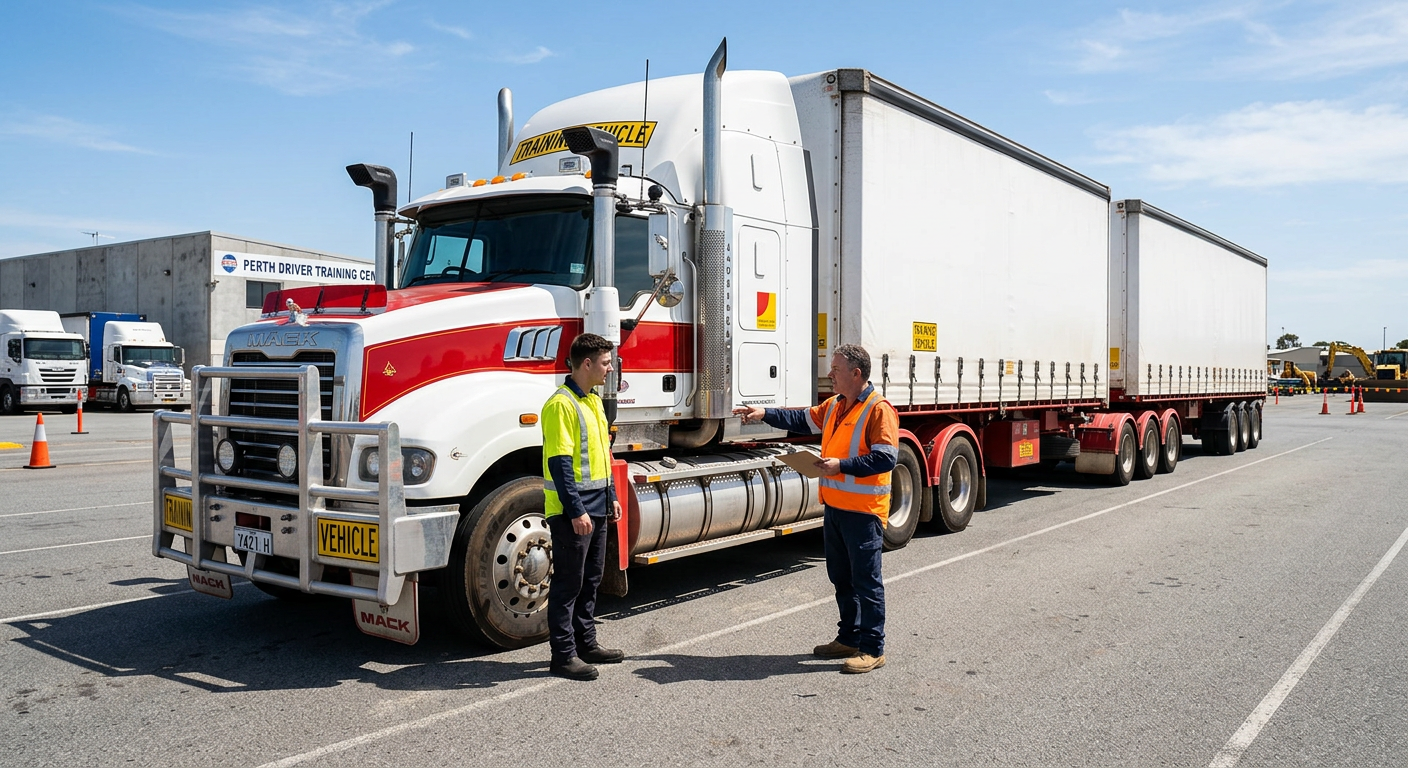
Moving from heavy rigid or heavy combination work into multi-combination driving is a meaningful step. The MC class covers heavy combination units towing two or more trailers, each with a gross vehicle mass greater than 9,000 kg. For a Perth driver, the useful question is which learning, practical training and assessment elements are included, and how those pieces fit together.
Our MC licence course covers TLIC4006, Drive Multi-Combination Vehicle, with online theory and practical assessments. Successfully completing the unit leads to a Statement of Attainment. That training outcome has a specific place in the upgrade process: it comes before the Department of Transport Practical Driving Assessment, known as the PDA.
We provide two days of one-on-one training with experienced, accredited trainers and assessors. The individual format puts your learning at the centre of the practical work. It also makes the distinction between learning and assessment important: time spent developing a skill is not the same thing as demonstrating that you meet the required standard.
There are separate milestones to plan around: completing the training unit, receiving your Statement of Attainment, passing the PDA and having your licence endorsed. Completing the course does not automatically authorise you to drive an MC vehicle.
Online Theory and Practical Learning
Our MC licence course brings online theory and practical assessments together within TLIC4006. Both contribute to the unit outcome. The online component is therefore part of the qualification work, not simply background reading for a driving lesson or an optional introduction that can be set aside when practical training begins.
Keep a short list of questions as you work through the material, using an example where possible. For instance, consider what you understand about a multi-trailer combination and which part you need your trainer to explain. This gives your preparation a practical focus without turning it into memorising isolated phrases or trying to predict the assessment.
Two Days of One-on-One Training
Our practical format provides two days of individual training. For the on-road component, our pricing schedule specifies eight hours of training, divided into 5.5 hours on the first day and 2.5 hours on the second.
Those figures give a more useful picture of the driving allocation than assuming that two days means two full working days behind the wheel.
The important inclusion is the individual format: your own driving is the focus. One-to-one delivery gives our trainers the opportunity to concentrate on teaching correct driving techniques while you concentrate on the task at hand. It is a learning arrangement, not a promise that every driver will progress at the same pace.
Practical feedback is most useful when you can connect it to a decision you remember. After an exercise, consider what you noticed, what action you chose and what you would change next time. That approach keeps the discussion concrete.
Bring your existing heavy vehicle experience into our one-on-one training at Blue Horse Truck Driver Training. You might be comfortable with one task and less certain about another. Explaining those differences gives the conversation a clearer starting point than describing yourself only as experienced or inexperienced. The aim is to make your learning needs specific enough to address.
From the Training Unit to the PDA
Once you have successfully completed the unit and received your Statement of Attainment, you can proceed to the PDA eligibility stage. Our Department of Transport-approved assessors conduct the PDA to assess competency for the licence upgrade. This is a separate licensing assessment following the unit outcome, not another name for the practical assessments within TLIC4006.
In Western Australia, MC class driving assessments can only be completed through an approved registered training organisation. The official assessment guidance also explains that the organisation must verify eligibility through the Licence Assessment Provider System. Completing training is one part of readiness; the licensing eligibility requirements still apply when the PDA is due to take place.
On the day of the PDA, the training organisation must confirm your eligibility again. An expired driver’s licence, for example, can prevent the assessment from proceeding. Keep your licence validity in view while planning the course and assessment dates, particularly if a renewal falls close to your intended training period.
Approved registered training organisations must use in-cabin video, audio recording and GPS surveillance when conducting heavy vehicle PDAs. You must sign the camera acknowledgement on the Heavy Vehicle PDA Customer Eligibility form, Form E114, to acknowledge that your assessment will be recorded using in-cabin cameras.
You can request to view your recorded PDA by contacting the training organisation that conducted it. If you have concerns or questions after reviewing the footage, the official guidance directs you to the Department’s Heavy SAA team. Knowing that a viewing request is available gives you a specific way to revisit the recorded assessment if you need to understand an aspect of it afterwards.
After passing the PDA, you must visit a Department of Transport and Major Infrastructure service centre or regional agent to have your licence endorsed. You are not authorised to drive the upgraded vehicle class until that step is complete. Bring the required identification and a photocopy of the completed Heavy Vehicle PDA Customer Eligibility form signed by the training organisation.
Eligibility Before You Enrol
For an MC upgrade in Western Australia, you must have held a car licence for at least three years and a Heavy Rigid or Heavy Combination licence for at least one year. The official MC guidance sets out both experience requirements. Holding a Medium Rigid licence alone does not satisfy the HR or HC requirement for this pathway.
Our student information also identifies HR or HC as the relevant prior heavy vehicle class for an MC upgrade. When preparing your enrolment details, separate your total driving experience from the time you have held each required class. A long history of car driving does not replace the specified heavy vehicle holding period.
The approved training organisation must obtain a completed and signed Heavy Vehicle PDA Customer Eligibility form and a satisfactory commercial vehicle eyesight test. Medical eligibility declarations also form part of the process. You must also declare any alcohol-interlock condition or restriction that applies to you. Official guidance states that training and assessment will not proceed if the required medical or alcohol-interlock declarations are not made, and you will be referred to the Department. These requirements sit alongside the licence holding periods, so eligibility is not established by counting years alone.
Tell us before booking if a medical condition, restriction, disability or injury may affect your training. Some circumstances may need referral to the Department of Transport for approval. Giving that information early allows it to be addressed before you commit to arrangements; it should not be left until the assessment day or treated as something the driving result will resolve.
Course Timing and Costs
Our course pricing lists the MC course at $2,490 on weekdays and $3,100 on weekends or public holidays. It describes a ten-hour course, including the eight hours of on-road training outlined above.
Extra lessons and reassessment are separately priced. Additional MC lessons are listed at $265 per hour on weekdays and $295 per hour on weekends or public holidays. Reassessment is listed at $990 on weekdays and $1,090 on weekends or public holidays. Those separate charges matter when budgeting for further training or another assessment attempt.
Choose your preferred dates with both attendance and preparation in mind. A weekday booking and a weekend booking have different published prices, but price is only one part of organising the course. Leave yourself a workable opportunity to engage with the learning material, attend the practical sessions and deal with the later licensing steps without assuming everything finishes at once.
A Clear Path Into MC Driving
Your course decision comes down to whether you meet the entry requirements, can attend the two-day individual format and have budgeted for your preferred weekday or weekend option. Use those practical considerations to choose an attendance plan that works alongside your existing commitments.
For your enrolment discussion, get in touch to work through the MC course arrangements, your preferred training dates and the preparation needed for each stage.


Leave A Comment