

A two-day MC course is easier to understand when preparation, the longer first practical day and the shorter second practical day are treated as one sequence, not two identical appointments. Our MC course includes two-day, one-on-one training with experienced, accredited trainers/assessors. The advertised course duration is 10 hours, including eight hours of on-road training: 5.5 hours on day one and 2.5 hours on day two.
For someone comparing MC truck training Perth options, that split gives a useful starting point for organising time away from work. It is not a minute-by-minute lesson plan or a promise of a licence after two days. The practical booking, successful completion of the training unit, the licensing assessment and licence endorsement are distinct parts of the pathway.
Prepare Before the First Practical Day
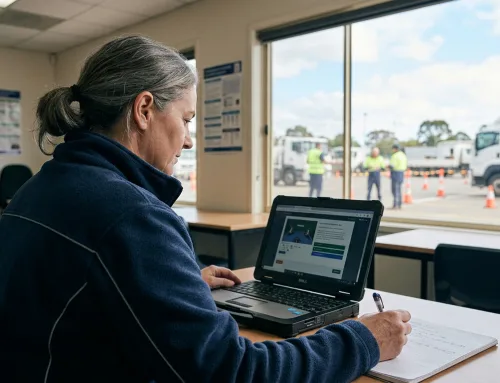
Our MC course requires successful completion of online theory and practical assessments for TLIC4006 Drive Multi-combination Vehicle to obtain a Statement of Attainment. Make space for the online work when organising your booking, and follow your enrolment instructions for its timing. Do not build your own timetable on the assumption that the first morning is reserved for theory.
Preparation also means having your licence history ready before committing to practical dates. For an MC upgrade in WA, you must have held a car licence for at least three years and an HR or HC licence for at least one year. An MR licence does not meet that MC experience requirement. Resolve any uncertainty about your holding dates before arranging time off.
Keep the practical arrangements together in one place: your booking instructions, arrival details and any preparation you have been given. For the official experience requirements, use Transport WA’s MC licence guidance. Having the eligibility and attendance details settled leaves you free to concentrate on learning when the practical training begins.
Day One Has the Larger On-Road Allocation
We allocate 5.5 hours of on-road training to day one of the two-day MC licence course. That is the larger practical block, so it deserves the most space in your diary. If you are arranging a shift change, childcare or travel, use that training commitment as your starting point and allow for the arrival and departure arrangements in your booking.
A longer opening session creates room to settle into the vehicle and road environment, work through activities directed by your trainer/assessor and identify what needs attention on your return. Approach it as a substantial learning session. Trying to squeeze it between a full work shift and another fixed commitment can leave little room to arrive calmly or absorb feedback afterwards.
The 5.5-hour figure describes on-road training, not a complete start-to-finish attendance window. Use your booking instructions for when to arrive and when you can reasonably plan to leave. This distinction matters when someone else is collecting you or when your employer needs an absence window: the training allocation alone is not an appointment confirmation.
Plan food, water and rest before the practical day. Keep personal preparation simple enough to follow. For example, organise your journey beforehand and put anything requested for attendance together the evening before. These are practical ways to reduce distractions, not a prescribed lesson schedule or a list of additional course requirements.
Carry Useful Feedback Into Day Two
The two days should be connected, not treated as separate attempts to cover the same ground. Before leaving the first session, make a short personal note of feedback you want to retain: a sequence that felt unfamiliar, a road situation you want clarified or an instruction you need to apply more consistently. Record the specific point while it is fresh.
A useful note is concrete enough to act on. “Remember the feedback about positioning” is more helpful than “drive better”, particularly if you also record the situation in which it arose. Keep the note consistent with your trainer/assessor’s instructions. Its purpose is to help you resume the learning, not to replace instruction with your own driving method.
Day Two Is Shorter, but Still Substantial
Day two has 2.5 hours of on-road training. Protect that time as a continuation of the course, not optional revision. Arrive alert and ready to return to the practical work, with the first day’s feedback still clear. A shorter session gives you a good reason to make the journey predictable and avoid bringing an unrelated deadline into the training day.
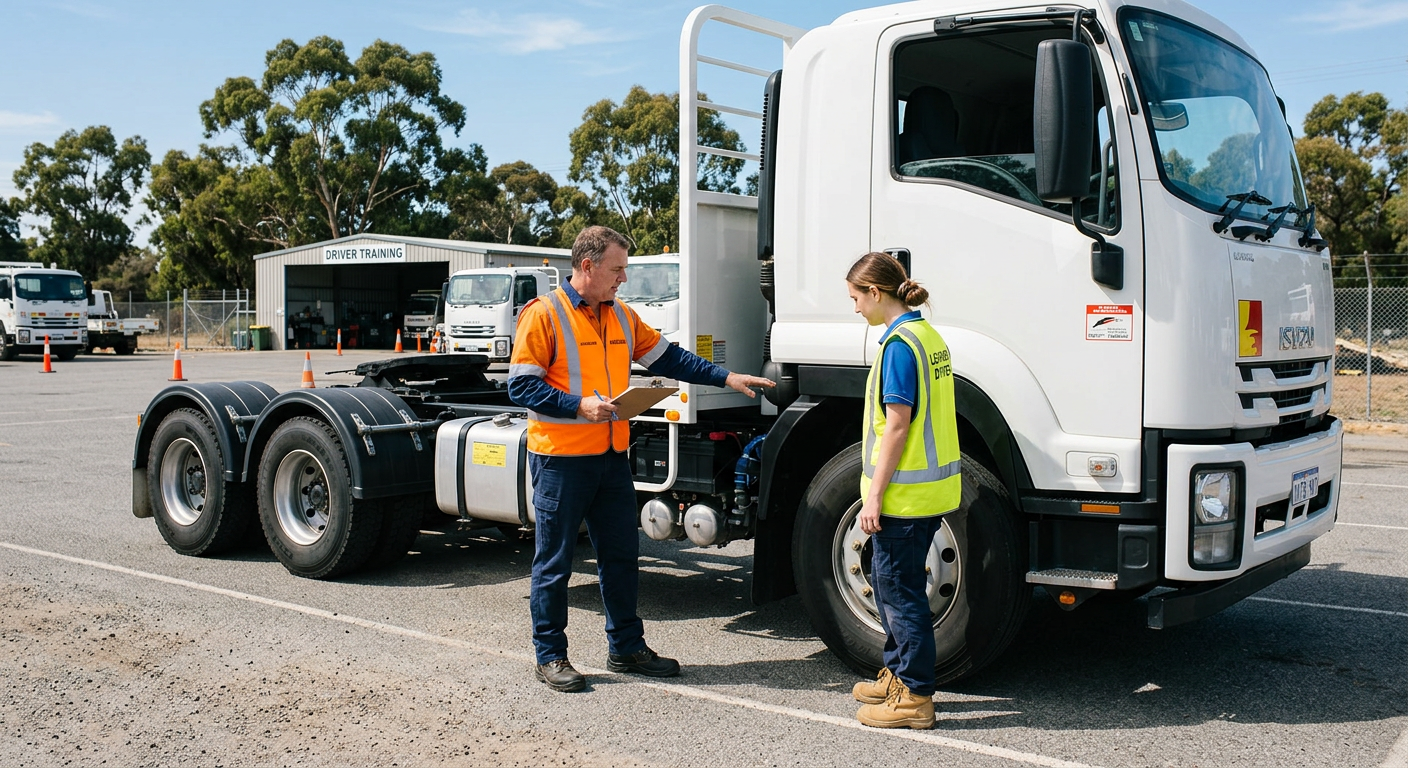
Our one-on-one MC training at Blue Horse Truck Driver Training gives you an individual setting in which to work with your trainer/assessor. Use that setting to make a difficulty specific: explain which instruction you found hard to apply or which situation left you uncertain. That gives the conversation a practical focus without assuming that every learner needs the same lesson sequence.
Let your trainer/assessor direct how the practical work proceeds. There is no need to invent a separate plan simply because the second day is shorter. Assessment readiness is not established merely by reaching the end of the advertised training hours.
Understand the 10-Hour Course Figure
Our course pricing lists a 10-hour MC course with eight hours of on-road training. Read those figures together when comparing options. Ten hours is the advertised course duration; it is not ten hours of on-road training. The stated road-training allocation is divided unevenly across the two days, with the larger share on the first day.
The remaining two hours are not broken down into a universal timetable in that listing. Do not assign them to theory, administration, breaks or a fixed PDA slot when planning your attendance. Keep your own diary based on the arrangements supplied for your booking. This avoids turning a broad course-duration figure into a schedule that has not actually been provided.
Separate Unit Completion, the PDA and Endorsement
Successful completion of TLIC4006 and issuance of your Statement of Attainment make you eligible to undertake the Department of Transport Practical Driving Assessment, conducted by our DoT-approved assessors. Our MC course follows that distinction between completing the unit and undertaking the licensing assessment. A Statement of Attainment is not, by itself, an endorsed MC driver’s licence.
In WA, MC driving assessments can only be completed through an approved registered training organisation. The RTO must also confirm your eligibility on the day of the PDA. These requirements explain why the assessment is a separate milestone, not an automatic outcome of attending two training days. Leave its precise timing to your actual assessment arrangements rather than assuming it occupies a particular part of day two.
After passing the PDA, you must visit a DTMI service centre or regional agent to have your licence endorsed before you are authorised to drive the heavy vehicle. Transport WA explains this final step in its RTO assessment guidance. If you are organising work around the upgrade, keep endorsement separate from both the training finish and the assessment result.
Budget for the Booking Category
Our listed MC course price is $2,490 on weekdays and $3,100 on weekends or public holidays. Both categories show the same 10-hour course and eight-hour on-road training allocation. The choice of booking category therefore changes the listed price, not the stated 5.5-hour first-day and 2.5-hour second-day split. Use the category that matches your proposed attendance when planning your budget.
Extra lessons are listed separately at $265 per hour on weekdays and $295 per hour on weekends or public holidays. Reassessment is listed at $990 on weekdays and $1,090 on weekends or public holidays. Keep these separate from the initial course cost in your budget; they are not automatic additions to every booking. Prices and available dates should be settled as part of the booking arrangements.
If the PDA Is Deferred
If you defer or are not ready to sit your PDA, our stated policy keeps it in credit for a maximum of three months from your last training date. Our student information sets out this assessment-credit provision. The relevant reference point is the last date of training, not the date you first enquired or began the online work.
If that situation arises, record the last training date and raise the next assessment arrangements promptly. Do not treat the maximum credit period as a recommended gap in your learning. Keep any booking correspondence together so that the dates and agreed next steps are easy to refer to. This credit provision does not replace any rights you have under applicable consumer law.
Put the Two Days Into a Workable Diary
Build your plan around the unequal practical blocks, with enough surrounding time for travel and the attendance arrangements you receive. Prepare for the online and practical assessment requirements, use the first day to establish useful feedback and bring that feedback into the shorter return session. Keep the unit outcome, PDA and endorsement as separate milestones when deciding when you may be available for MC driving work.
Before reserving leave, contact us to align your proposed two-day attendance with the booking’s arrival and finishing arrangements. Have any fixed work or travel commitments for either day to hand.






Leave A Comment