Moving from HR driving towards an HC upgrade calls for preparation that covers the whole combination. Start with the vehicle arrangement, then connect control, observation and vehicle condition to the tasks you need to learn. That gives your preparation a clearer purpose than simply aiming to feel comfortable in a larger truck.
If you are researching HC licence training in Perth, use your existing driving experience as a starting point for identifying learning needs. Write down what you already understand about positioning, traffic observation and vehicle checks, alongside anything unfamiliar about operating a combination. Treat this as preparation for instruction, not a self-assessment of readiness to pass.
The heavy combination training skills in TLIC3005 include systematic vehicle control, monitoring traffic and road conditions, managing vehicle condition and performance, coupling and uncoupling a trailer, and managing hazardous situations. These areas belong together in your preparation. Reversing, for example, deserves attention alongside the observations and vehicle-management work surrounding it.
Our HC course is TLIC3005 Drive heavy combination vehicle. Keep the training unit and the licence upgrade as distinct milestones when planning your preparation. The unit gives you a useful skills framework; the formal licensing process also has eligibility, application and assessment requirements. Neither should disappear from your planning simply because you already drive an HR vehicle.
Start With the Configuration You Are Learning For
An HC licence covers a prime mover with an attached single semi-trailer and HR vehicles, including those with an attached trailer whose Gross Vehicle Mass exceeds 9,000 kg. Its scope also includes MR, LR, car and moped entitlements. Use the main combination descriptions to name the arrangement you intend to learn in. “A truck with a trailer” is too broad a description for a useful conversation about your training goals.
Transport WA also permits an HC holder to tow one other trailer in addition to the attached trailer or semi-trailer, with that additional trailer limited to a maximum GVM of 9,000 kg. An unladen converter dolly or low loader dolly is also permitted. The single semi-trailer description therefore does not establish an absolute one-trailer limit. Our HC course information sets out the training pathway for the HC unit; the configuration you intend to operate gives that learning a specific focus.
Practise Systematic Vehicle Control
The official TLIC3005 unit requires the vehicle to be started, steered, manoeuvred, positioned and stopped in accordance with traffic regulations and manufacturer instructions. These are related skills, but each has its own outcome. Starting and steering do not settle whether positioning is accurate or stopping is controlled. Give each action attention during instruction, including how it fits into the complete movement of the combination.
Efficient control does not mean hurried control. The unit requires engine power to be managed for efficiency and performance while minimising engine and gear damage. It also addresses maintaining engine operation within the manufacturer’s specified torque range and temperature through effective gear selection and smooth gear changes. The learning task connects the control used, the engine’s operating limits and the vehicle’s response, rather than treating gear selection as an isolated action.
Braking is another explicit skill: the heavy combination’s braking system must be managed and operated to ensure effective vehicle control under all conditions. Make braking a topic for vehicle-specific instruction. Understanding which control is being used and the outcome it is intended to achieve gives that instruction a clear purpose. The requirement concerns effective control, not simply familiarity with the location of the controls.
Reverse With Visibility and Positioning in Mind
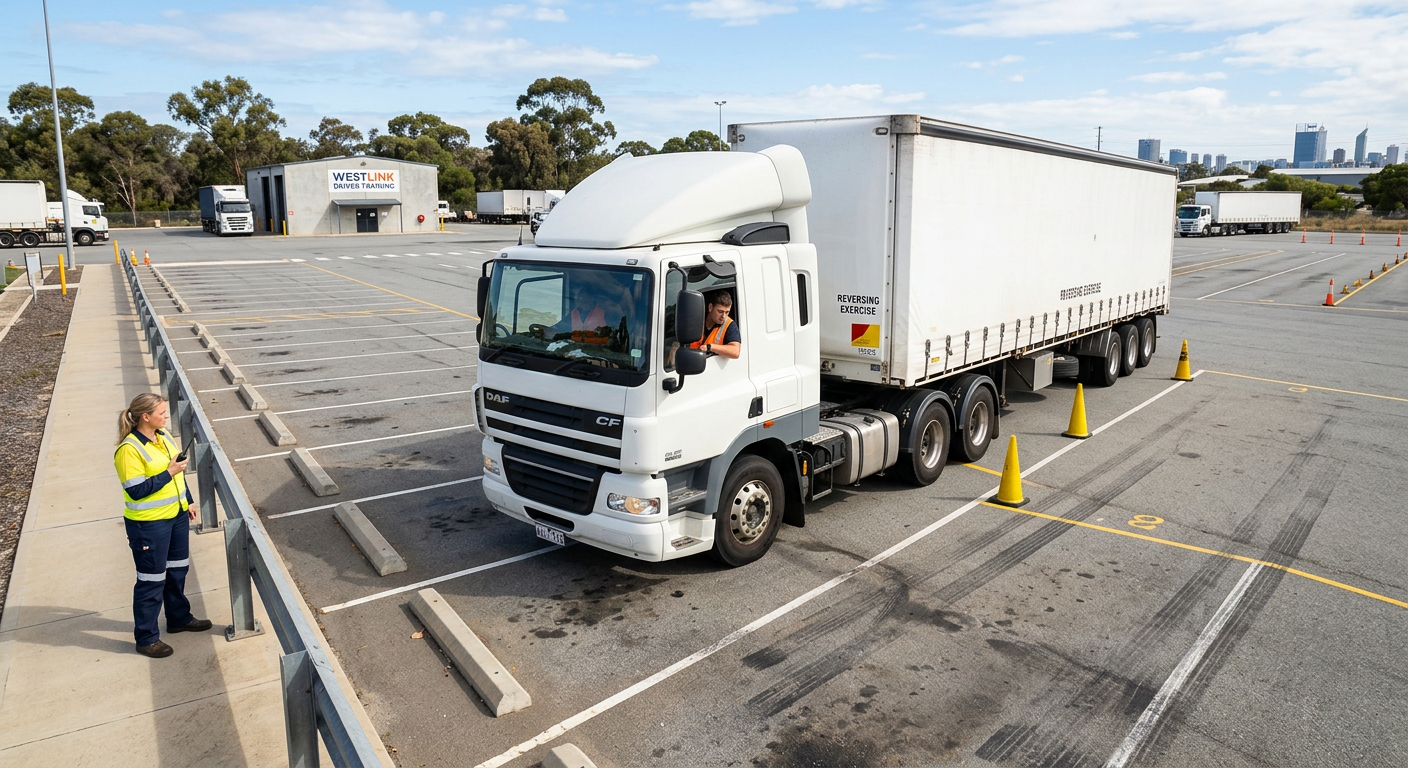
TLIC3005 includes driving the heavy combination in reverse while maintaining visibility and achieving accurate positioning. Both parts matter to the learning goal. Reaching an intended position addresses only part of the wording; maintaining visibility is part of the same task. That makes reversing a combined observation-and-control skill, not just an exercise in placing the vehicle at an endpoint.
For preparation, “I need instruction on maintaining visibility while positioning the combination in reverse” is more specific than “I need more reversing.” It identifies the relationship that needs attention without prescribing a manoeuvre. Use the trainer’s directions for the actual exercise and vehicle. The unit establishes the skill to develop, but it does not provide a universal steering sequence or promise a particular assessment layout.
Learn Coupling as a Complete Task
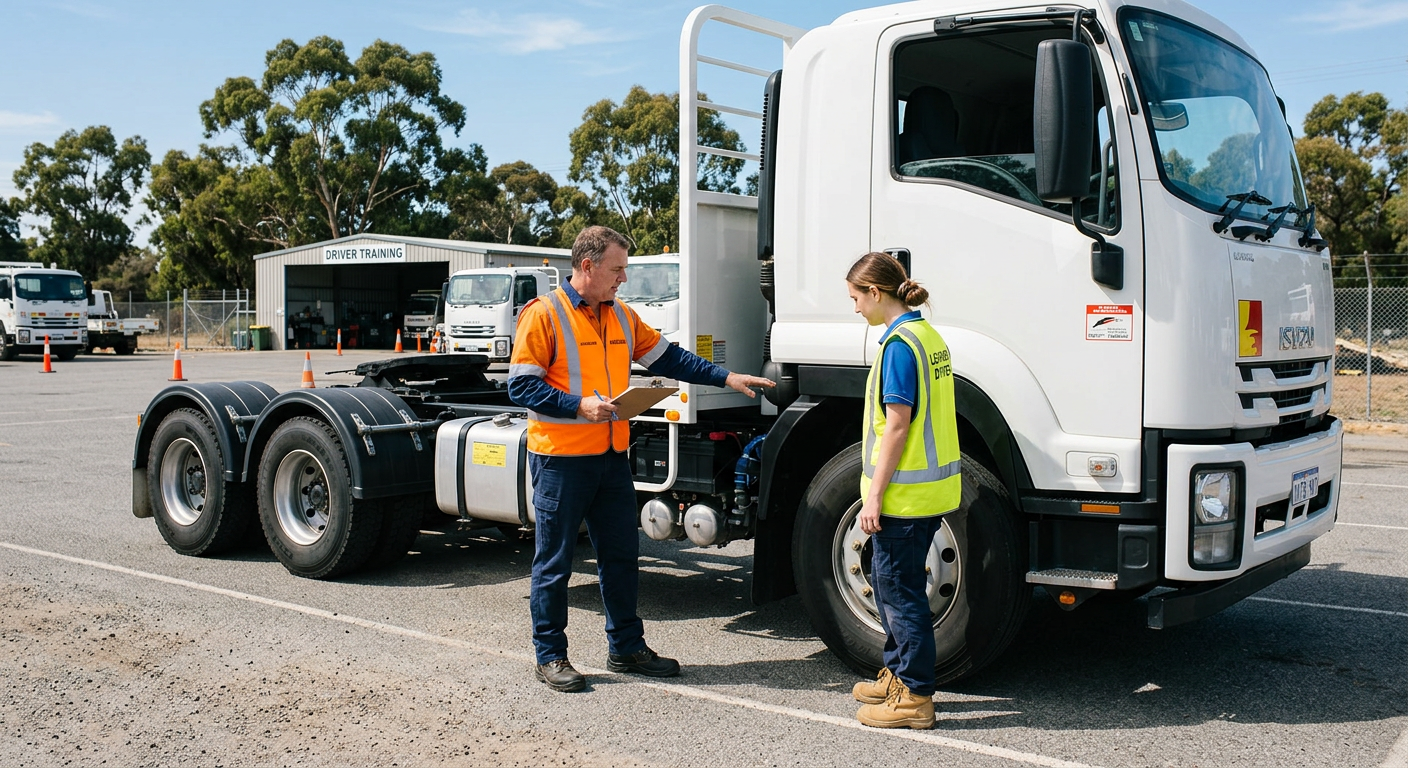
Coupling deserves its own place alongside road driving. Our one-on-one training at Blue Horse Truck Driver Training gives you a setting in which to focus on learning correct driving techniques. Use that individual instruction to develop your understanding of combination-specific tasks, including the relationship between alignment, coupling and the subsequent checks. This keeps the connection between components within the wider task of preparing the combination for operation.
The unit requires the prime mover and trailer to be aligned and coupled in accordance with manufacturer instructions and workplace procedures. It then requires the coupled vehicle to be checked and tested to ensure it is correctly secured and fully operational. Coupling and the subsequent checks and tests are separate requirements. Learning the complete task means understanding both the connection and the verification that follows it.
Uncoupling also belongs within a wider vehicle-management task. TLIC3005 requires the vehicle to be parked, uncoupled, shut down and secured in accordance with manufacturer specifications, traffic regulations and workplace procedures. The complete outcome extends beyond separating the vehicle components. Parking, shutdown and securing remain part of the required work, with the applicable instructions and procedures determining how it is carried out.
Monitor Traffic and Road Conditions as a Combination Driver
Traffic monitoring is continuous work. TLIC3005 requires traffic and road conditions to be constantly monitored and acted on for safe operation and to prevent injury or damage. Observation and action belong together: noticing a developing condition is one part of the requirement, while responding to that information is another. During instruction, connect what you observe with the driving decision being explained.
Route planning is part of the unit too, including monitoring and anticipating traffic flows, road standards and factors likely to cause delays or route deviations. This broadens the learning beyond individual manoeuvres. The route is not simply a line between departure and arrival; the unit requires attention to conditions that can affect the journey. Keep that forward-looking task alongside the continuous monitoring needed while driving.
Manage Vehicle Condition and Performance
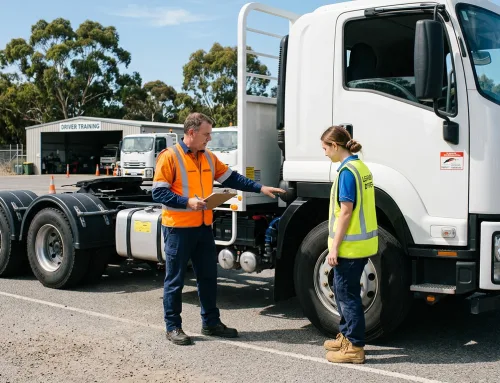
Vehicle-condition management begins with pre-operational inspections and vehicle checks, which are specified in TLIC3005. The unit also requires performance and efficiency to be monitored during use. These are connected learning areas: preparation before driving and attention to the vehicle while operating it. Signage and lights are another explicit requirement, with checks covering operational effectiveness and conformity to prescribed traffic regulations.
Defective or irregular performance and malfunctions must be reported to the appropriate authority under the unit’s requirements. Vehicle records must also be maintained or updated, with information processed according to workplace procedures. Recognising an issue, reporting it and recording the relevant information are related responsibilities, but they are not interchangeable. The reporting requirement identifies what must happen to information about a defect; recordkeeping addresses how vehicle information is maintained.
Treat Hazardous Situations as a Planning Topic
TLIC3005 requires driving hazards to be identified or anticipated and avoided or controlled through defensive driving. It also requires appropriate procedures to be followed in a driving emergency. Anticipation and emergency response therefore deserve separate attention. One concerns recognising and managing a developing hazard; the other concerns following the appropriate procedure when an emergency occurs.
Systematic control and monitoring belong in the same learning conversation. A review of a supervised drive can connect the information available with the decisions explained by the trainer. The unit also includes completing and submitting over-width and overweight permit applications in accordance with regulatory requirements where required. This is a conditional responsibility, not a statement that every HC journey needs a permit, and it extends preparation beyond physical vehicle handling.
Understand the WA Licence Pathway
To apply for an HC upgrade in WA, you must not be a provisional licence holder and must have held a C-class licence for at least three years and an MR or HR licence for at least one year. Both holding periods matter. The HC licence guidance also sets out the steps to learn to drive, submit an application in person, and book and pass the Practical Driving Assessment.
Our course requires successful completion of the online theory and practical assessments for TLIC3005 to obtain a Statement of Attainment. Successful unit completion and issuance of that statement make you eligible to undertake the Department of Transport PDA conducted by our DoT-approved assessors. Unit completion and the PDA are separate stages, so preparation needs to account for both without treating the statement as an automatic licence upgrade.
Passing the PDA is not the final administrative step. Transport WA’s RTO assessment guidance states that, after passing, you must visit a DTMI service centre or regional agent to have your licence endorsed before you are authorised to drive the upgraded vehicle class. Include that endorsement step in your plan alongside the practical learning, rather than treating a successful assessment as immediate permission to drive independently.
Turn Your Skills Brief Into Focused Preparation
Your preparation should now cover the complete combination: controlling it, reversing with visibility, coupling and verifying the connection, monitoring conditions, managing vehicle information and responding to hazards. Bring the learning needs you identified at the start into an HC course discussion. We can discuss those priorities when you speak with us about developing your combination-driving skills through our HC training. Keep the practical learning and the separate licensing milestones in view throughout your upgrade.


Leave A Comment